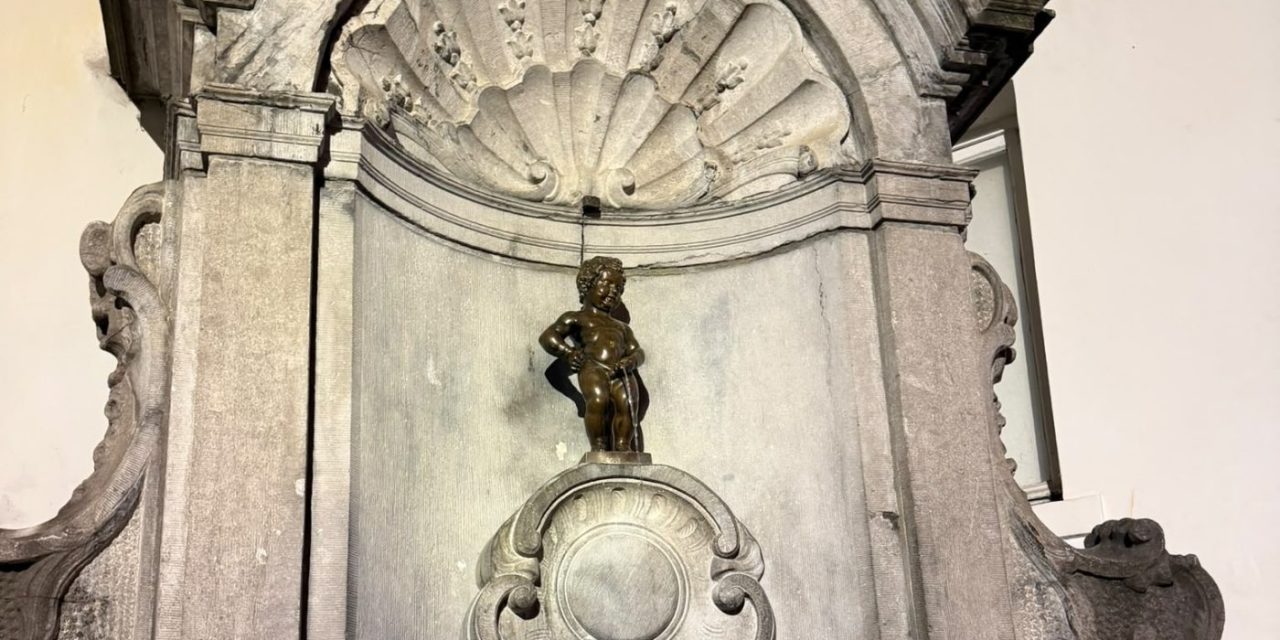
In the buzzing heart of Brussels, on a quiet street corner, stands a small landmark with a huge reputation: Manneken Pis. This little bronze statue, of only 55 centimeters tall, is a beloved cultural icon, and it means a great deal to the city and its people. Over the years, he has been dressed in more than a thousand different costumes, from football kits for the World Cup to a costume for the climate march in Brussels and outfits specifically designed for diplomatic visits. The GardeRobe of MannekenPis has requirements for anyone who wants to submit a costume. The question is: have those lines blurred over time?
The custom of dressing Manneken Pis has evolved over the years and the statue’s collection now holds 1211 costumes, kept in the GardeRobe of MannekenPis and in the Brussels City Museum.
Alongside postwar internationalization, the growth of tourism, and cultural globalization, dressing the monument evolved into a means of cultural communication. Costumes are donated by foreign dignitaries, embassies, and cultural organizations as a way of expressing and negotiating national identity. According to the GadeRobe of MannekenPis, he wears 20 to 30 different costumes a year. He isn’t dressed every day, but roughly on 150 to 200 days a year. His costumes follow an official ceremonial calendar that varies with events, seasons, and remembrance days, in contrast to the majority of historical monuments. This cycle of rotation and renewal means that the statue’s meaning is constantly changing.
Today, costumes are meant to stay non-political, non-commercial and non-religious, but some argue that clothing can never be truly neutral. Can a Manneken Pis costume carry a message?
Janice Deul is a Dutch fashion and culture activist who has worked with fashion as a medium to convey a message and she knows its power. For more than a decade, she has advocated for diversity and inclusion through demonstrations, fashion and art. ‘’Fashion is a catalyst for change. You can use its power, because it’s not merely about clothing. It’s a medium, a tool, an instrument to communicate an important messages about culture, identity, history, belonging and politics.’’ Deul states that fashion can have more impact and be more powerful than it first seems.
She notes that fashion can be called a form of soft activism, because it can be more subtle than other forms of activism. ‘’It’s low-key and everyone can connect with fashion. Fashion is on our skin, so it really is an extension of who we are and who we want to be.’’ She argues that even when you wear something that you think is ‘’neutral’’, you are already communicating that you want to be neutral.
When it comes to Mannken Pis, Deul sees the costumes as something positive.’’The aim of art and culture and a statue like this is to interact with its surroundings and the people of the community. ‘’ Asked whether a landmark could be a target for activists to get their point across, she says it depends, but they must use it in a way, as long as it’s done in a socially responsible. She calls it a win in the public space, when people are encouraged to interact with a cultural figure in any shape or form and says that it shows that the monument is being considered as a living thing. ‘’I think that’s something we have to applaud,’’ she adds. ‘’The only thing they need to consider is that if people don’t see a meaning in fashion, they may miss the point.’’
That brings Deul to the question if fashion and the costumes can be neutral. She doubts that anything can be neutral, including clothing. ‘’We bring ourselves in whatever we do or think. We all have our experiences, our upbringings, our thoughts.’’ She says that is normal because we are humans not robots. ‘’This doesn’t have to be something bad or negative, as long as we acknowledge that no one can be neutral ever. ‘’