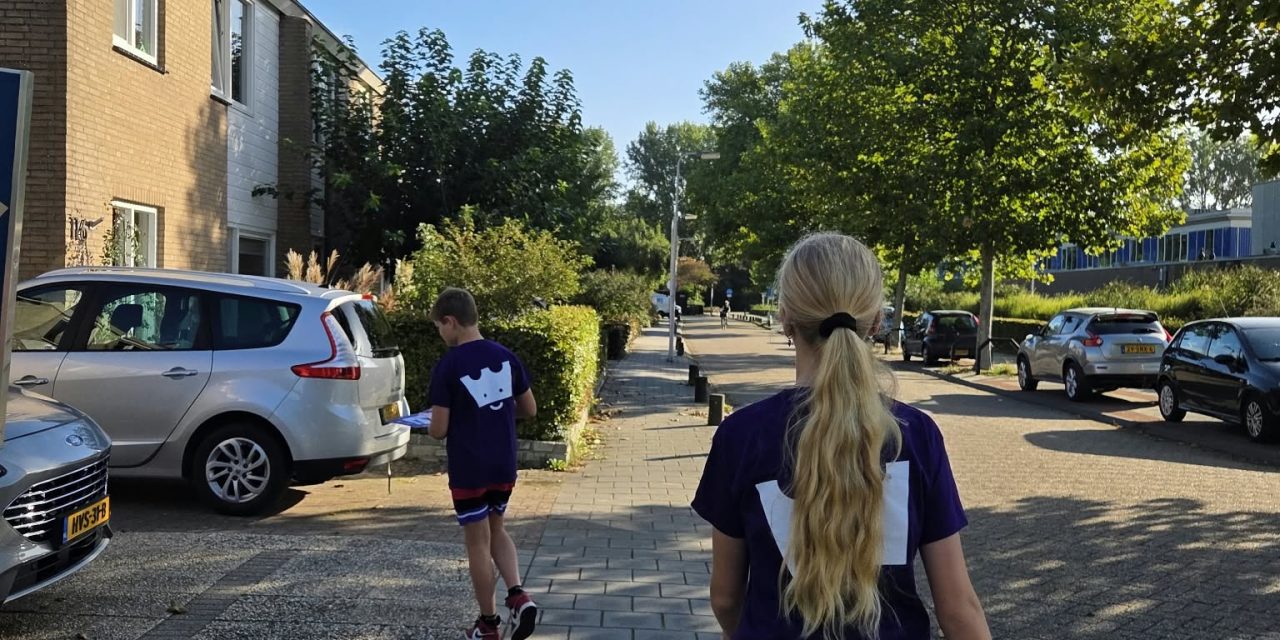
The annual Dutch Children’s Stamp Campaign kicked off this Wednesday afternoon, with several ceremonies, where the children went out in their neighbourhood and the first sales were made. Every year, thousands of Dutch primary school children go door to door, to sell poststamps to raise money for charity. This Dutch tradition continues at a time when children in several European countries are becoming less independently mobile, so the question is what can other countries learn from this initiative that gives children the opportunity to go out on their own?
Decline in Europe
The term children’s independent mobility is the travel of a child to different destinations, such as friends’ homes, school, local shops or playgrounds, or explicitly independent walking, travelling or cycling without adult supervision.
Research comparing children’s independent mobility in 2018 found that the independent mobility of children has declined in several European countries between 1990 and 2010. Some countries that had relatively high levels of independent mobility experienced a significant decline, like in Germany, the percentage of children aged 7–15 who were allowed to travel on their own fell from 93% to 76% and in Finland from 85% to 65%. This study didn’t say anything on the decline in the Netherlands.
In another study in 2020 it found that in the Netherlands, independent mobility increases sharply with age of 8–12-year-olds, independence increases over the years. 36% of 8-year-olds travelled to school independently, compared with 91% of 12-year-olds.
These figures do not specifically measure children going door to door, but they show the wider decline in opportunities for children to move around independently.
A Dutch example for Europe
Pedagogue Martin van Rooijen also sees the decline in children’s independent mobility in Europe and the Netherlands. He explains that children need opportunities to do things on their own, without adults constantly being involved. ‘It is important that children can and are allowed to do things on their own like travelling alone, ‘he says. ‘They need to experience what that is like, sometimes doing things that feel a little scary but choosing to do them anyway. This can help build confidence, resilience and dealing with disappointment, ‘ Van Rooijen says.
He sees the Dutch Children’s Stamp Campaign as an example of how children can increase the independent mobility ‘I think it’s a good initiative for children to have the freedom to approach people themselves.’ Van Rooijen also adds: ‘I think it could be a good example for other countries to do something similar, because it encourages children in another way to explore their neighbourhood.’
Van Rooijen believes that going from door to door is valuable for children, because it gives them the opportunity to experience something new on their own. ‘They might find it a little exciting, but I think that is exactly the point.’
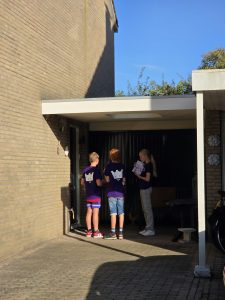
Waiting for the first customer

Making their first sale
Organisation point of view
The campaign also comes with questions about the safety of the children. The organisation has adapted to concerns from parents over the years: children no longer carry cash and receive safety instructions before going out.
According to Albert de Leeuw and Marieke Andriessen from the organisation, however, safety concerns do not necessarily reflect what happens in practice. ‘It is more the concern from parents than something actually happens when the children go out on their own,’ they explain. They say the campaign has not necessarily become less safe, but that measures have been introduced in response to wider concerns in society. ‘I don’t think it has necessarily become safer, but the measures were simply taken to create a sense of safety.’
Andriessen says the campaign is about more than collecting money. ‘It is more than just going door to door and selling stamps. The children learn to approach people they do not know, step outside their comfort zone and take responsibility.’ De Leeuw describes it as an initiative ‘with and for children.’
Perhaps that is what makes the Dutch tradition interesting beyond the Netherlands: not the stamps themselves, but the opportunity for children to step outside, meet people, take responsibility and do something for others.