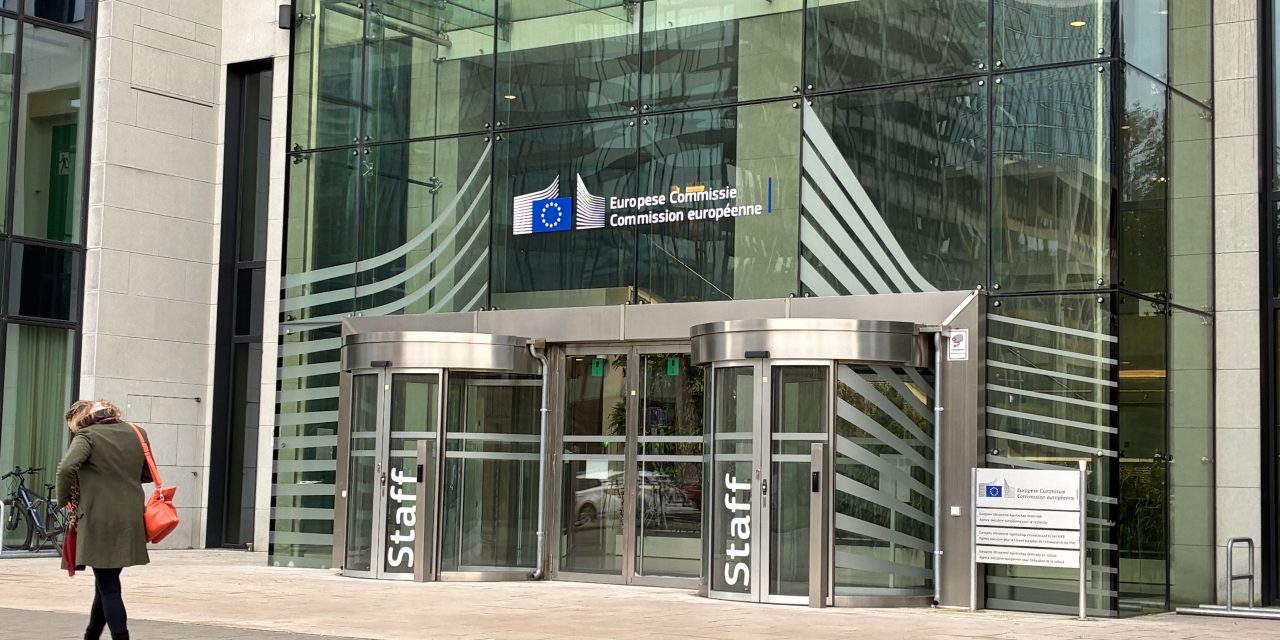
„The EU is a Union of Equality […]. This foundation of the EU legal order implies an environment free from racism, where everyone can thrive and contribute to the prosperity of their societies.“ This statement can be found in the EU-Anti-Racism Strategy for 2026-2030, adopted by the European Commission on the 20th of January 2026. Yet, barely six months later, the Commission decided not to renew the funding for the largest network against racism in Europe. How can the EU aspire an “environment free from racism” if they decide to no longer fund the fight against it?

The building of the EACEA in Brussels, where the discontinuation of the operating grant for ENAR was decided. Photo taken by Linda Doose
The European Network against Racism loses European Commission funding
Only a seven-minute walk from the Brussels-North train station one can find the building of the European Education and Culture Executive Agency (EACEA). Here it was decided. “In July 2026, EACEA finally rejected ENAR’s proposal to the 2026-2028 partnership agreement (FPA)”, as explained by the European Network against racism’s (ENAR) communications officer Amira Salama. For nearly 30 years, the European Commission operating grants enabled ENAR to coordinate over 140 anti-racist organizations, influence EU policies, conduct research on structural racism, and support citizen-led initiatives, which is expressed in ENAR’s official funding loss statement.
Asked about the reason behind this decision, European Commission’s spokesperson Eva Hrnčířová states that “ENAR lacks the operational capacity needed to ensure the required performance of the contract […]“ and that this „prevents it from qualifying for a FPA for the work programmes 2026-2028.“ However, ENAR officially disagrees with this statement and therefore filed a lawsuit against the EACEA before the General Court of the European Union, especially criticizing the repeated questioning over months during the administrative procedure of the grant renewal for seeming like “a search for a pretext for a decision already made.”
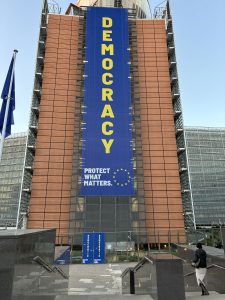
“Protect what matters”, but not protecting the work ability of the biggest network against racism in the EU. Banner on the Berlaymont building of the European Commission in Brussels. Photo taken by Linda Doose
The aftermath of the EACEA’s decision
The consequences of the discontinuation of the operating grant are drastic, since according to ENAR’s communications officer, the Commission provided up to 80% of their funding. Therefore, the EACEA’s decision deeply affected the networks ability to work and the lives of their employees, as now about 80% of them had to be layed off, most of them people from radicalised minorities, as Amira Salama remarks. So, this specifically affected the people that the European Commission stated to want to support and stand up for in their Anti-racism strategy.
But the consequences go beyond severely weakening ENAR’s operational capacity and the network possibly having to cease its operations eventually. Brussels based Senior Policy Officer and Lead for Rule of Law Advocacy of the European Civic Forum, Aarti Narsee, explains that this has far-reaching repercussions for civil society organizations all over Europe. At the structural level, it starves local groups of vital backing by dismantling the connection and effectively having “cut this crucial bridge that exists” between European networks and national anti-racism organizations. Additionally, it creates a “chilling effect” across civil society, pushing critical organizations to “play things a bit safe” or self-censor out of fear of financial retribution. Ultimately, this undermines democratic checks and balances by eroding the “very important watchdog role, which is essential in a democracy.”
“And this is why we collectively need to express solidarity, and we need to raise the alarm on this issue. Because an attack on one organization is actually an attack on all.” (Aarti Narsee)

Office building of the European Civic Forum’s Brussels location. Photo taken by Linda Doose
“It’s a symptom of a broader context”
ENAR’s defunding is not an isolated incident. “It’s a symptom of a broader context,” Aarti Narsee emphasizes, pointing to an increasingly hostile European climate where non-profits face rising political attacks, smear campaigns, and shrinking civic space.
These political pressures are further compounded by severe bureaucratic hurdles. Corinna Karlsen, Project and Finance Officer at the Brussels School of Governance, highlights how EU funding mechanics inherently disadvantage smaller organizations and citizen-led groups. Applying for and maintaining Commission grants is “very resource intensive,” requiring “lots of rules, lots of administration” and strict “financial control.” For smaller civil society organizations fulfilling vital advocacy roles, surviving such demanding administrative processes is getting harder by the day.
When escalating political hostility meets overwhelming administrative barriers, the future of independent advocacy hangs in the balance. If the European Union continues to squeeze the financial lifelines of its watchdog organizations, its promise of an “environment free from racism” will remain nothing more than empty words on paper.


“George Floyd” and “Multiculturality Balance the World”, both pieces of street art can be found strolling through the streets of Brussels and were painted to set a sign against racism and for cultural diversity.Photos taken by Linda Doose