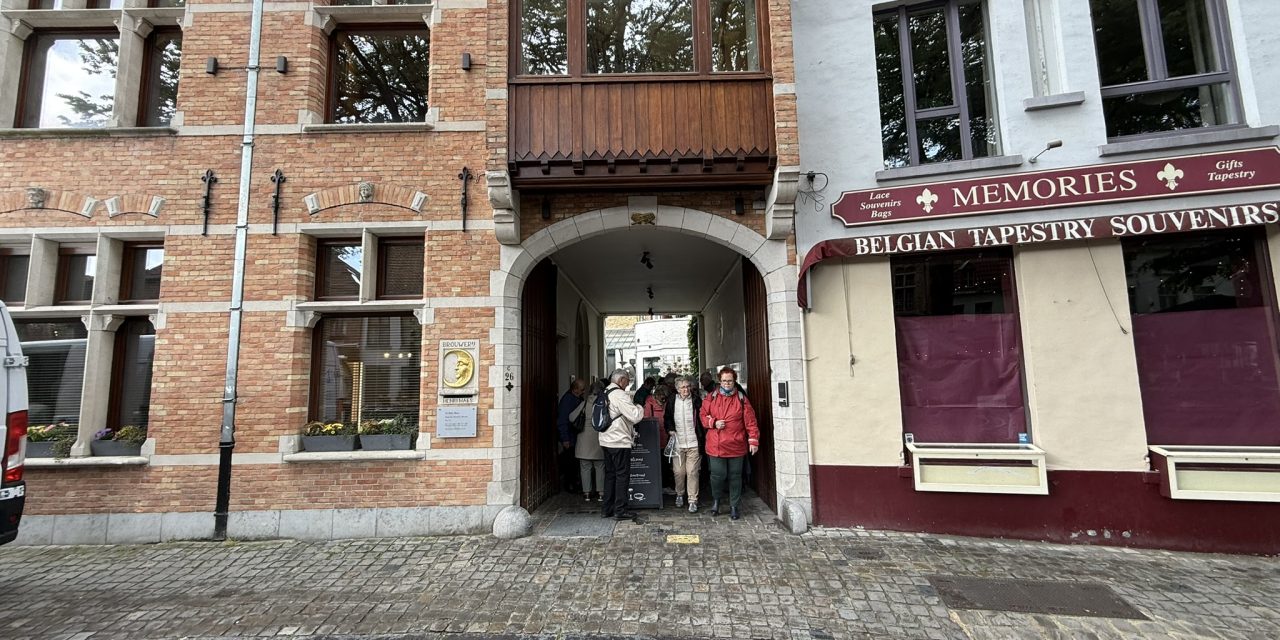
A rainy morning in May, not the best weather for a city trip to Bruges but still the Walplein is getting busy with early-rise tourists. One of the main tourist spots in Bruges is not one you would imagine getting up early for. It is Brewery De Halve Maan, best known for specialty beers such as Brugse Zot and Straffe Hendrik.The square is small, and not safely accessible for many trucks due to narrow medieval streets. The bottling plant of the brewery is 3.2 kilometres away, just outside the city centre. What is a good solution for the traffic difficulties in a medieval city? A beer pipeline, of course.
Running underneath Bruges’ cobblestone streets, the pipeline transports beer directly from the brewery to the bottling facility. It reduces truck traffic, lowers emissions and preserves the character of the historic city centre. More importantly, it demonstrates that innovation and heritage do not have to be enemies.The idea for the pipeline emerged as the brewery searched for ways to continue operating in the historic city centre without increasing pressure on Bruges’ narrow streets. Transporting beer by truck between the brewery and the bottling plant had become increasingly difficult. Rather than relocating production outside the city, De Halve Maan chose to invest in a solution that would allow the brewery to remain in its historic location.Constructing the pipeline was not straightforward. Engineers had to navigate a densely built medieval city containing archaeological remains, historic infrastructure and modern utility networks. The project also required significant financial investment. Part of the funding came through a crowdfunding campaign, which attracted supporters from around the world. Contributors received beer-related rewards and helped raise approximately €400,000 for the project.
Since becoming operational in 2016, the pipeline has transported thousands of litres of beer every hour and eliminated an estimated 500 truck journeys through the city centre annually. Brewery employees describe it as not only a practical logistics solution but also a storytelling tool that has become part of Bruges’ identity. What began as a response to a transport problem has evolved into a symbol of innovation within a historic environment.That balance between preservation and progress is something Bruges deals with every day.”The question is not only how we protect our historic centre,” says the head of Bruges’ Monument and Heritage Department. “The question is also how we make sure it remains a livable city.”Since 2021, he has led one of Belgium’s oldest municipal heritage services. Founded in the early 1970s, the department advises on restoration projects, building permits and urban developments in the city centre. It also manages restoration subsidies, organizes heritage events and helps oversee Bruges’ UNESCO World Heritage status.Bruges is unique in having three UNESCO recognitions: the Beguinage, the Belfry and the entire historic city centre. While this international recognition brings prestige, it also creates challenges.
The city faces what heritage experts call the “UNESCO paradox”: recognition attracts visitors, but growing tourism can threaten the qualities that made the site valuable in the first place.Yet the heritage department does not view preservation as freezing the city in time.”If a city is no longer a place where people can live, work, study and do business, then eventually it becomes an empty city,” the heritage official says.
For Bruges, heritage conservation therefore goes beyond maintaining old buildings. Housing, mobility, education, healthcare and economic activity all play a role in keeping the city alive. Schools are a good example. Historic school buildings in the city centre face increasing demands for accessibility, sustainability and energy efficiency. At the same time, developers are eager to acquire valuable urban land.The city actively works to keep schools in the centre because they help maintain a permanent local population. Without residents, families and students, Bruges risks becoming little more than a tourist destination.
The same thinking applies to infrastructure. As visitor numbers increase, so does pressure on public services. To reduce the impact of waste collection trucks, the city recently introduced underground waste systems capable of storing much larger volumes of rubbish. New swimming zones have also been created in the city’s waterways, reconnecting residents with the historic canals that define Bruges.Even the famous cobblestone streets are being reconsidered. While they contribute to the city’s medieval atmosphere, they are not always comfortable for cyclists. Officials are exploring ways to improve cycling conditions while preserving the historic streetscape.
Not every proposal survives the heritage test. The department recently opposed suggestions linked to widening a canal used for shipping between Ghent and Ostend. One proposal raised the possibility of moving a medieval city gate to accommodate larger vessels.For the heritage department, that was a step too far.Instead, authorities are investigating innovative bridge designs with a limited visual impact. The goal is to modernize infrastructure without sacrificing centuries of history.This approach reflects a broader philosophy. Rather than preventing change, heritage regulations often force planners and businesses to find more creative solutions.
The beer pipeline beneath Bruges is perhaps the clearest example. Faced with logistical challenges in a densely built medieval city, Brewery De Halve Maan developed a solution that respected the historic environment while meeting modern economic needs. For the heritage department, that is exactly the kind of innovation Bruges should encourage. To visitors, Bruges may appear unchanged since the Middle Ages. Behind the medieval facades, however, the city is constantly adapting. The challenge is not choosing between heritage and innovation, but finding ways for both to coexist. Sometimes, that means thinking outside the box. Or, in Bruges’ case, beneath the street.