The City of Brussels already has a network of urban farms and wants to strengthen its position as a frontrunner in urban agriculture. Now, it plans to make ten additional hectares available by 2030. As the city expands its urban farming activities, could Brussels become an example for other European cities?
In Neder-Over-Heembeek, on the outskirts of Brussels, a farm grows vegetables for around a hundred families in the neighbourhood. But there is more going on at La Ferme Urbaine than growing vegetables. The project, run by the organisation Le Début des Haricots, also gives people who have been out of work for a long time the opportunity to learn a profession.“People are paid to work here and learn how to become a farmer,” says Arthur, a project manager at the farm.
Near this farm, the City of Brussels has made one hectare of land available as part of its expansion plans, but is still looking for an operator to run the site.
More than growing vegetables
For Francisco Dávila, a researcher and biologist, the importance of urban farming cannot be measured only by the number of vegetables produced or families fed. In a study of 14 urban agriculture projects in Brussels, Dávila and his colleagues identified 110 different functions. “There is of course food production, but also circular economy, health, training, social cohesion, and so many more,” he says.
Multiple of these qualities, can be found at an urban farm in Molenbeek. Hidden between large apartment buildings lies a field, full of crops. It is part of Groot Eiland, an organisation with several projects across the Brussels-Capital Region. Patrick de Coster, who works there, says: “Our basic mission is to try to help people with limited access to the labour market towards employment.”
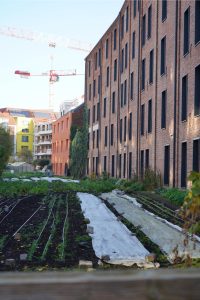
In Molenbeek, the farm uses a technique called ‘Small Plot Intensive Farming’ or SPIN, growing mainly leafy greens and herbs that can be harvested up to six times a year.
In the middle of the city, workers grow organic vegetables. After harvesting, the produce travels by bicycle to restaurants run by Groot Eiland, other restaurants and the organisation’s organic shop. “We are the shortest chain in Brussels, only 50 metres in some cases,” De Coster says.
Greener and cooler cities
Urban farms also contribute to the green spaces that cities increasingly need as temperatures rise. According to Brussels Environment, temperatures in the centre of Brussels are on average three degrees Celsius higher in summer than in the surrounding rural areas. This is known as ‘the urban heat island effect’.
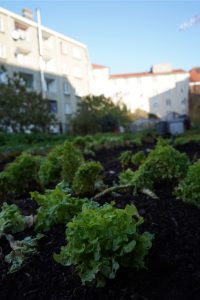
Rainwater collected from flat rooftops provides the farm in Molenbeek with all the water it needs, as long as there are no long periods of drought.
De Coster has noticed this difference himself. He lives on the outskirts of Brussels and describes feeling the cooler air when he takes the tram out of the city. “Every tree, every green space in the city is absolutely welcome,” he says.
The struggle to make it work
Growing food in a city is not straightforward. Space is limited, sunlight can be blocked by surrounding buildings and finding clean soil is not always easy. Dávila says soil pollution is a major concern. Before starting an agricultural project, the soil needs to be tested to make sure it is safe for growing food.
Access to land is another major obstacle. Research by Alessandra Manganelli and Frank Moulaert found that urban agriculture projects in Brussels face competition from other demands, particularly housing. Dávila also describes how farming projects can lose their land when it is needed for construction, making it difficult for farmers to plan for the long term.
There is also the question of money. At La Ferme Urbaine, families pay at the beginning of the season, giving the farm more certainty about its income. But even with this arrangement, making a living from growing vegetables remains difficult. Arthur says subsidies are important for the project’s survival. Without it, “maybe only two or three people can have a salary. A very low salary.”
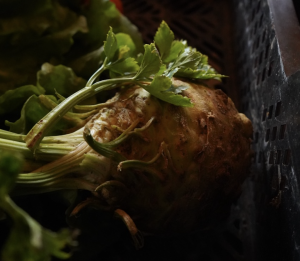
La Ferme Urbaine tries to grow many different vegetables to supply their customers with a wide variety.
A model for other cities?
The aim of Brussels’ strategy is not to make the city self-sufficient in food. Urban agriculture cannot replace farming in the countryside. Instead, it can complement food production outside the city while bringing environmental and social benefits closer to residents.
For Dávila, Brussels shows that urban agriculture can take many forms, from professional farms to community gardens and projects that combine farming with social employment. Other cities do not have to copy one particular model, but they can learn from the variety of initiatives already operating in the Belgian capital.
When asked what message Brussels could send to other cities, Dávila points to both the progress already made and the possibilities ahead: “First of all, it’s possible. And second, we can do better. I think in every city there is no reason it couldn’t develop urban agriculture.”