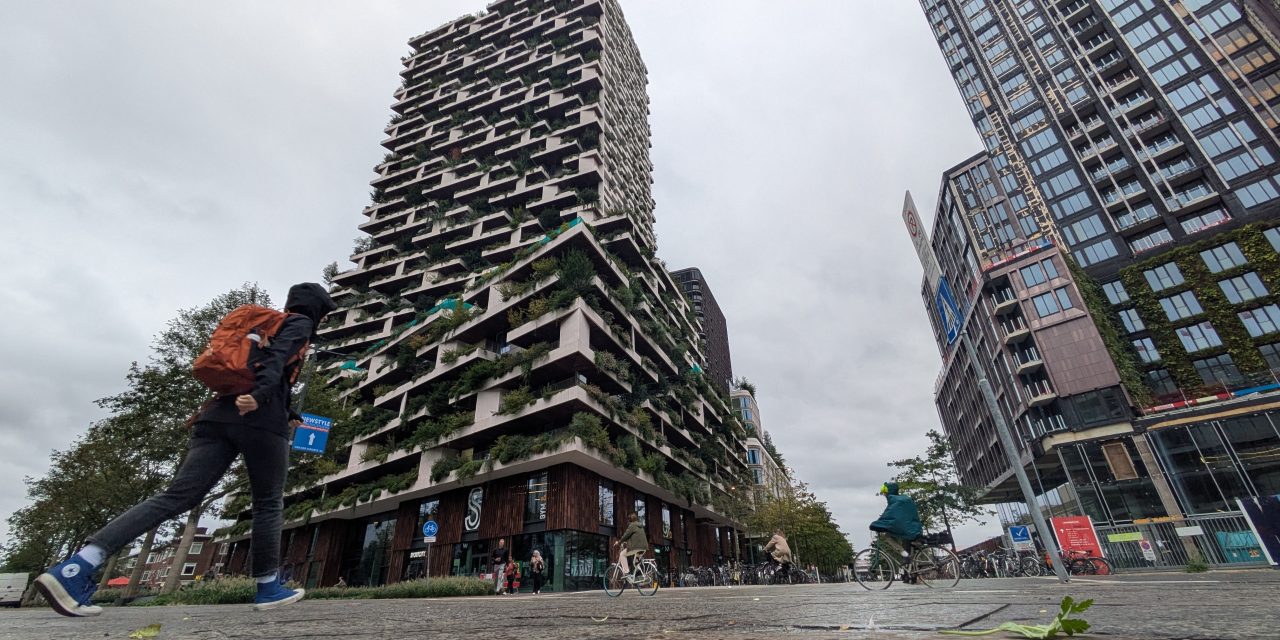
In the midst of concrete, glass, and metal buildings, Utrecht’s skyline is decorated by a green tower covered by vegetation.
This building is just one part of the Wonderwoods Apartment Complex, which calls itself a “vertical forest” on the architect’s website. Its green facade is striking, but it’s not the first of its kind.
“Singapore is really experimenting with this, more than we are doing in Holland,” says architect and engineer Eugene Zaaijer. He is the program leader of City Innovation Labs at Utrecht University’s Centre of Expertise for Smart Sustainable Cities.

Eugene Zaaijer describes his job as working on innovations that make cities healthier, more sustainable, as well as more fun.
“I think this is a trend to be developed further,” he continues. Vertical gardens and forests are becoming somewhat of a hot topic among architects.
Italian architect Stefano Boeri is the mind behind Utrecht’s Wonderwoods. His organisation Stefano Boeri Architetti has also designed similar vertical forests in other European cities. You can find their towers in Eindhoven, Antwerp, and Milan, as well as multiple other cities across the world, with more projects under construction.
Although popular among some Utrecht residents, the Wonderwoods is not without its critics. Some claim the project is an example of ‘greenwashing’, a term describing when a company makes itself appear greener than it actually is. The Utrechtse Bomenstichting (The Utrecht Tree Foundation) questions the building’s sustainability in a 2024 post.
“On the (Dutch-language) internet, you will find no criticism of Wonderwoods. Nothing but praise. No one dares to ask a few obvious critical questions,” the foundation writes. “For example, you might wonder how much extra concrete and steel is needed to ensure that balconies can be attached to the building to support heavy trees.”
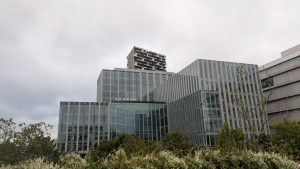
The Wonderwoods vertical forest sets itself apart from the rest of the skyline.
They go on to list more concerns, such as extra concrete and steel for water storage, energy costs of pumping water for irrigation during dry seasons, and expensive housing prices due to extra maintenance. As their main source, they cite a 2023 report from Swiss civil engineer Julien Pathe, called Impact environnemental de la Tour des Cèdres.
This report sets out to evaluate the environmental impact of installing trees on the vertical forest Tour des Cèdres in Chavannes-près-Renens, Switzerland, which is also designed by Stefano Boeri Architetti.
On their website, Stefano Boeri Architetti writes that the Wonderwoods, among other things, “… significantly contributes to improving city life quality by absorbing carbon dioxide.”
Pathe’s findings are not exactly in line with this claim. The study, which, for fairness’ sake, evaluated another “vertical forest”-style building by the same company, finds that the absorption of carbon dioxide does not cover the extra emissions caused by the added necessary infrastructure during construction.
Specifically, the study found that the vertical forest in Switzerland would need to plant 20,000 trees at the time of construction to make up for the extra emissions in a 60-year timeframe.
The building contains 80 trees.
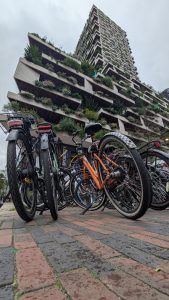
The advantages of the Wonderwoods are plenty according to some, but others argue the cons outweigh the pros.
Despite these added carbon emissions, the Wonderwoods enjoy an ‘Outstanding’ BREEAM certificate, which is given out by the Dutch Green Building Council. They write on their website that this “… underscores that sustainability is firmly embedded not only in the design and construction, but also in the daily use of Wonderwoods.”
Zaaijer explains that emissions are not the only relevant part of sustainable construction and city planning, and brings up heat stress as an example.
“If you have a lot of hard and stony areas, a city will get hotter,” the architect explains. “Cities are rapidly heating up, and this helps with combating this problem.”
Among other advantages, he mentions water buffering for the city, helping with storing water and mitigating the risk of flooding during periods of heavy rain.
“But I also think the effect of seeing green is good for people’s well-being, as well as the perception of the city and of what you can do yourself for sustainability. I think a green building like this will change your behaviour a bit. I hope so,” he says.