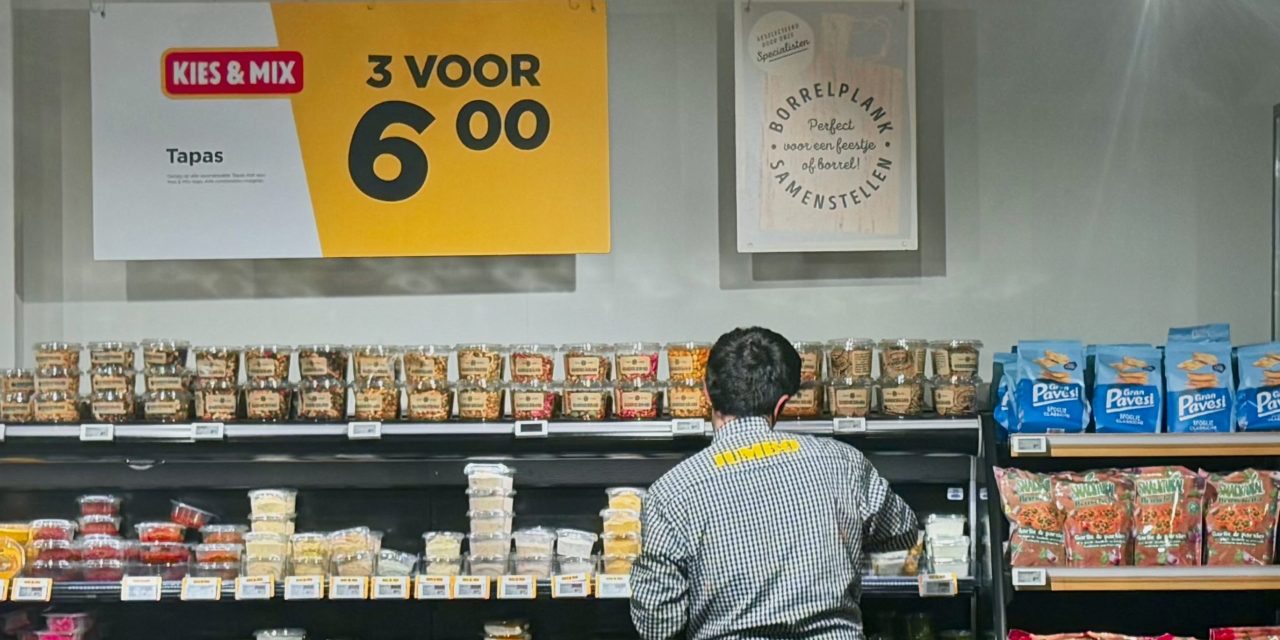
When entering a Dutch supermarket like Albert Heijn or Jumbo it’s practically impossible to avoid all the big flashy red and yellow sale signs: Buy one get one free. Buy five for the price of four. Buy two get the third one half price.
In the Netherlands they love a good discount just as much as anywhere else in Europe. Still, something is quite particular about the way Dutch supermarkets utilize campaigns and offers. Notably regarding their supermarkets where the multi-buy strategy – or “stapelkortingen” as they say in Dutch – is very commonly used. At first, this exclusively seems like a great deal for the costumer. Especially in a time of inflation in all of Europe. Yet, this phenomenon has actually been heavily criticised and is a hot topic of discussion in the Netherlands currently.
In 2023 The Dutch Consumers’ Association published a report titled “Increasingly larger discounts – how is that possible?” establishing and criticising bulk offers as the most common discount promotions in the supermarkets. A big part of the criticism in the report is based on the argument that bulk offers cause costumers to spend and consume more than necessary which then furthermore leads to overconsumption, unnecessary waste, exploitation, and environmental depletion. The Consumers’ Association also points towards other European countries when arguing against bulk offers. In Belgium for instance, the authorities forbade Albert Heijn from using the 1+2 free promotion in 2019. “Low prices are good for the consumer, but selling at a loss makes normal competition impossible“, said Kris Peeters (Belgian Minister for Consumer Affairs at the time). In other European countries like Denmark, France and Ireland these types of discounts are also a thing of the past.
So then, how come it’s very much a thing of the present in the Netherlands? According to Martin de Munnik (Co-founder and business developer at Neurensics) it falls back on the so-called supermarket war: “In the Netherlands we all live close together and there are a lot of shops which means that there’s a lot of competition (…) One supermarket started with a very competitive promotion called 1+1 free and basically then the other stores have to follow, whether they like it or not.”.
Martin de Munnik, apart from having a long background in advertising and marketing, has spent many years researching and studying how neuroscience can predict purchase behaviour. He explains that from a neuroscientific point of view a bulk offer is in most cases not the optimal strategy: “If those marketers at that time knew about neuromarketing or neuroscience, they would have known that in the brain it’s better to have a present (..) The present activates greed and desire more and more, but discounts activate symptoms of habit, which is not good”. He explains that when extreme discounted prices are offered repeatedly, they eventually become the new reference point rather than a special deal. Once that happens, the brain stops producing the same dopamine response and as a result, the offer loses its appeal.
From Martin de Munnik’s assessment it seems unlikely for any of the Dutch supermarkets to stop with these offers, but indeed the discount-chain Lidl announced in January 2026 that they are discontinuing bulk offers on food to be clearer and more transparent about the true price of products. The CEO of Lidl Netherlands Peter de Roos made this statement following the announcement: “The Netherlands has gone overboard with special offers. Offering a second product for free and volume discounts creates a sense of savings, but in practice, you often end up feeling cheated. The true price of a product should be the focus, so that customers know exactly where they stand.”.
Now the question remains: will the other supermarkets follow along? Either way, the supermarket war continues on and for now, it looks like those yellow and red sale signs are here to stay.