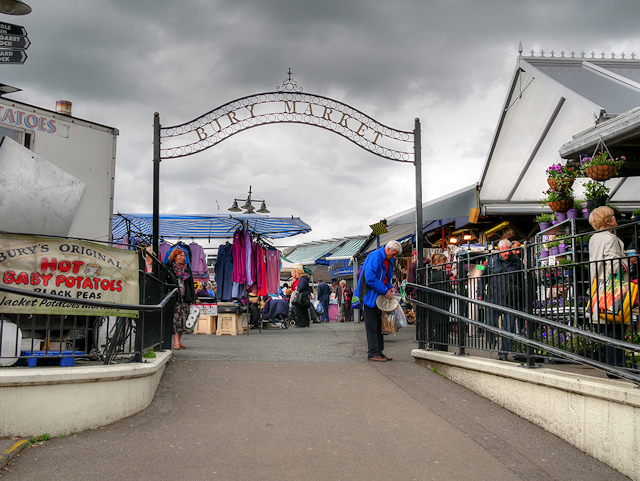
Bury is a post-industrial town that has spent decades in a state of transition. Once a landscape defined by cotton mills and manufacturing, it has had to adapt as industries declined and shopping patterns shifted toward a more digital world. Yet, in the heart of this post-industrial town, one constant remains: the nearly 600-year-old Bury Market.
As part of a new £20 million regeneration project funded by the Bury Council, the market is set to receive a “flexi-hall” and significant infrastructure upgrades. But for the local and surrounding community, the market represents more then just a place to buy and sell goods. It’s a centre where different generations of people come together to interact and socialise, while spending their money and sustaining the local economy. This happens to be more than just an idealogical story, as experts claim that there’s actual measurable returns of investments in local markets like the one in Bury. Returns that could even challenge the bigger multinationals.
The “Smarter Investment”
Joe Harrison, CEO of the National Market Traders’ Federation (NMTF), argues that markets are a “breeding ground” for the retail giants of tomorrow. He points out that household names like Marks & Spencer, Tesco, and Morrison’s all started as humble market stalls.
“Investing in the market is a smarter investment for the government,” Harrison explains. “When you invest in young people at these stalls, they become business owners who grow the economy and pay taxes back into the treasury”. He notes that by spending money with local traders, residents are “keeping the local economy far richer” because that money stays within the community rather than disappearing into the pockets of multinationals.
Relationships Over Transactions
The market’s survival is anchored in what Harrison calls the “feel-good factor”. Unlike the anonymous, transactional nature of supermarkets, a local market like the one in Bury offers human connection. Something sorely lacking when we partake in online shopping.
Among different generations of people working at the stalls, like the lads working at the Butcher stall, emphasise that the market is a vital training ground. “It’s a very good place to get your first job,” one trader explained. “You get hands-on work and learn a lot about how to handle yourself and run a business”. Beyond the skills, they believe the market offers something supermarkets can’t: “It’s about loyalty and friendship. In a supermarket, it’s just a transaction. Here, everyone is your friend, and people come because they want to socialize”.
This sentiment is echoed by the veteran traders. At the fabric stall, the owner works alongside her 87-year-old father at a business started by her grandparents after the war. Nearby, the Black Pudding Lady describes how the variety of stalls and the freshness of the produce keep people coming back every week, even as online shopping grows.
Quantifying Social Value
While the economic benefits are clear, the “social value” has historically been harder to measure. However, Harrison points to a study by the University of Leeds that proves markets provide a quantifiable community benefit. “Markets are community hubs where people meet friends and family in cafes,” Harrison says. “We’ve demonstrated that you can add this social value to the commercial value to see the total return on investment”.
A Crossroads for the Future
The planned £20 million investment is not without its critics. Some traders are skeptical about the “flexi-hall,” noting that recent infrastructure projects, like a new roof, haven’t always met expectations.
However, Harrison maintains that modernization is necessary for survival. He believes markets must embrace technology, such as “click and collect” services, while maintaining the face-to-face interaction that defines them. “You can’t run away from technology,” Harrison admits. “But we have to use it to get people into the hubs. You aren’t just buying from a screen; you’re buying from a person”.
As Bury navigates the pressures of the modern economy, the market stands as a testament to the town’s resilience. Whether through the 36 coach parties that arrive on a Wednesday or the local families shopping for their weekly groceries, Bury Market remains the “anchor” of the town. The upcoming regeneration is a gamble, but as Harrison suggests, it’s one that recognizes that a vibrant town center begins and ends with its market.