This production is made by: Kathrin Sack & Lara van Erp
A new European initiative could mark a turning point in how reproductive rights are addressed across the EU. Lawmakers are currently debating a proposal that supporters describe as a concrete step towards safe and accessible abortion care for women in all member states, including those where abortion remains almost entirely inaccessible. While the initiative has gained broad political support, questions remain about what it would actually change on the ground.
At the center of the discussion is My Voice, My Choice, a European Citizens’ Initiative that aims to reduce unsafe abortions and strengthen reproductive healthcare standards across member states, without directly having to rewrite national laws.
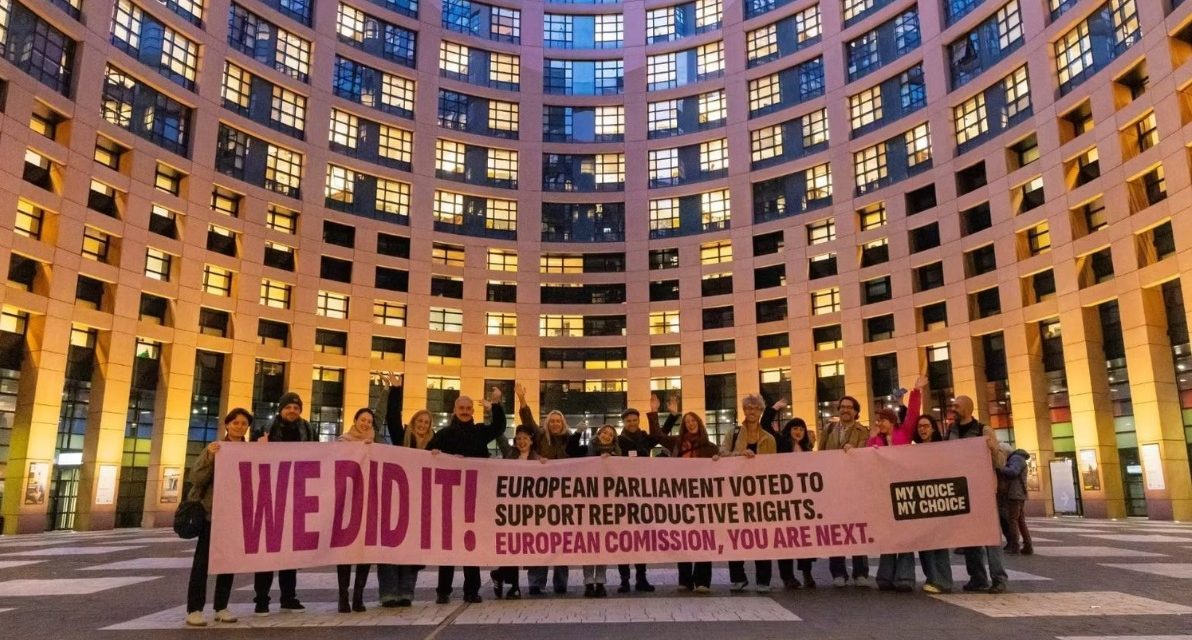
On December 17th, the European Parliament voted on the My Voice, My Choice initiative, a campaign aimed at improving access to safe and legal abortion across Europe. Members of the European Parliament (MEPs) were asked to decide whether to support a proposal that would help women who cannot access abortion in their own country. The vote resulted in 358 in favor, 202 against, and 79 abstentions, showing broad support across political groups.
The initiative does not force member states to change their national abortion laws, since that is an area where the EU has limited legal competence. Instead, My Voice, My Choice calls on the European Commission to establish a financial mechanism that would help cover the costs of abortion care for women who are forced to travel abroad due to legal restrictions in their home country. This could include funding for medical procedures, travel, accommodation, and related healthcare services. By doing so, the EU could reduce the number of unsafe abortions and ensure that access to care does not depend on a woman’s income or place of residence.
The initiative responds to the fact that, in many European countries, women still face significant legal and practical barriers to accessing abortion. This lack of access can be dangerous to women, putting them not only in serious physical risk, but also create a lot of mental stress. Research – including studies from the World Health Organization (WHO) – shows that restricting access to abortion does not reduce its occurrence, but instead pushes women toward unsafe procedures, putting lives at risk.
My Voice, My Choice campaign coordinator Nika Kovač said the initiative was born out of frustration with the EU’s lack of action on women’s rights. “We started this campaign because we wanted a different Europe, one that listens to its citizens and stops looking away while women’s fundamental rights and lives are threatened,” she said right after the parliament voted on the initiative.
Reproductive rights across Europe
Across Europe, access to abortion remains deeply uneven. While lots of European countries have expanded reproductive rights in recent years, many maintain restrictive, leaving women with limited or no legal options.
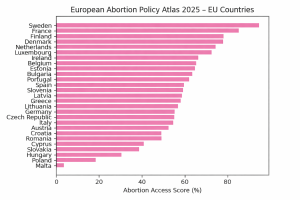
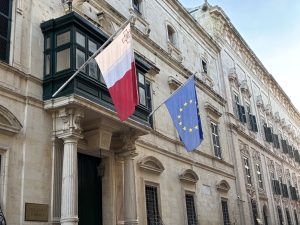 Malta remains the most restrictive country within the EU where the procedure is still illegal in almost all circumstances when it comes to abortion. For years, women on the island have had to travel abroad or obtain abortion pills illegally online, often putting themselves at significant personal and emotional risk. However, the country still provides the least reproductive rights in the EU, with only 3.4% access according to the European Abortion Policy Atlas 2025. The law now allows abortion only if a woman’s life is at risk, and even then, three doctors must agree before the procedure can take place.
In the absence of broader legal access, several civil society initiatives in Malta have emerged to provide women with information and support. One of them is Family Planning Advisory Service (FPAS), a fully confidential platform working in collaboration with Doctors for Choice and the Women’s Rights Foundation, which offers guidance on contraception and abortion, including advice on how to obtain abortion pills from abroad.
Another initiative is Women for Women, a Facebook-based community administered by Jelena Bezzina, where women share health concerns, ask questions and seek peer advice. The group is linked to the Women for Women Foundation, an NGO funded entirely through donations, fundraising and volunteer-led activities. While the group is not dedicated exclusively to reproductive rights, Bezzina says it often serves as a first point of contact for women seeking information.
Bezzina, who also supports the work of FPAS, says demand for abortion pills remains significant in Malta despite the country’s restrictive legislation. “We know that around 600 pills are sent to Malta every year, and we are certain that there are more, as this is just the number we are aware of,” she said.
Although the My Voice, My Choice initiative would not change Malta’s abortion laws, supporters say it could provide EU-backed financial support for women seeking care abroad, assistance that is currently offered only by NGOs.
Initial progress, but still a long way to go
Even as the European Parliament’s vote offers renewed hope, activists in Malta say the fight is far from over. Because even if the initiative comes through, abortion care in Malta remains illegal. Many women on the island acknowledged the problem of women- and reproductive rights far before legal action within EU was taken, and they have not been silent since. Their voice will continue to be heard until access to abortion in their country is treated as a fundamental right, not an exception. Their stories, shared in a documentary, reflect what it means to live in a country where reproductive care is not a given, but an aspiration to fight for.
Abortion in Malta: an activists’ story