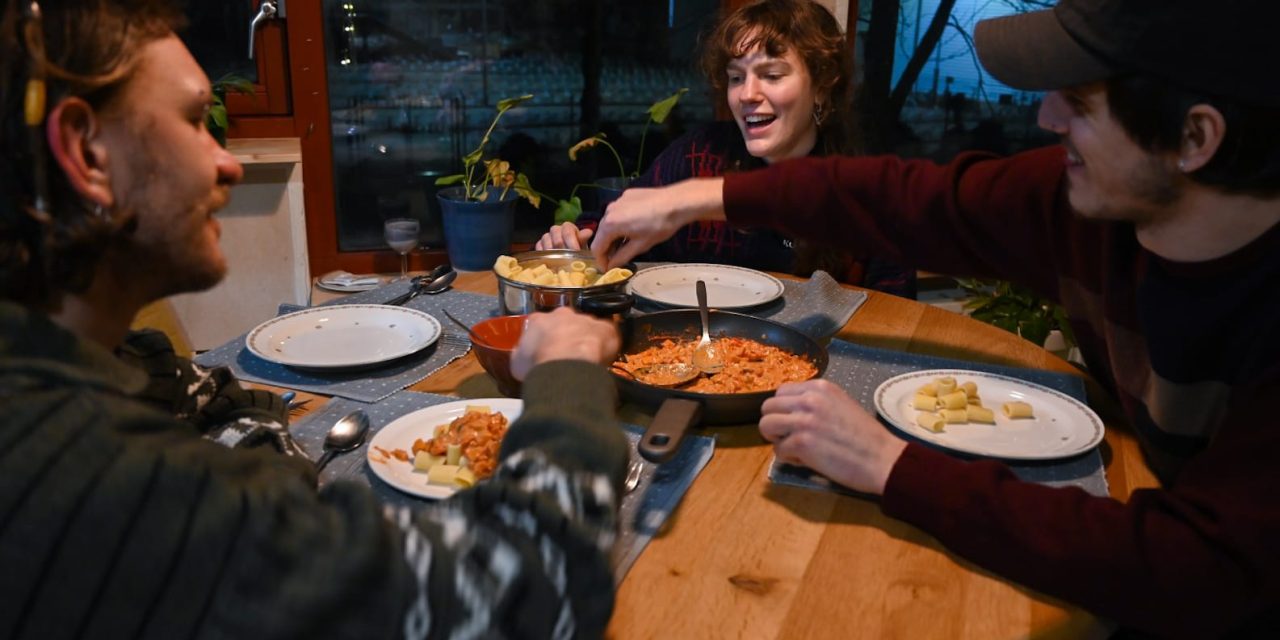
It’s six o’clock, which in the Netherlands means one thing: dinnertime. Potatoes are drained, vegetables divided, plates portioned with precision. Outside, playdates end abruptly and children who do not belong to the household head home or simply wait on the couch. But for those who grew up in cultures where dinner tables stretch to include whoever happens to be present, the ritual can feel surprisingly final.
For many Dutch families, this scene is entirely unremarkable. Dinner is a fixed point in the day, often between 5pm and 6pm, and typically reserved for the nuclear family. But for those who grew up elsewhere, the ritual can feel surprisingly closed.
For Milad, now 33, who fled to the Netherlands from Afghanistan at the age of nine, it was one of the first cultural differences he remembers noticing. “Back in Afghanistan my mom cooked for everyone, even strangers. In a lot of Eastern countries food means community, warmth and family. Religion also plays a role. In Islam, if someone asks for food, you are expected to give it.”
When he started primary school in the Netherlands at 12, he quickly learned that playtime had a deadline. “I remember being at a friend’s house and being told it was time to eat and they didn’t have food for me. It was a shock to me. I understood as them not liking me, because I was not allowed to eat with them. They didn’t even have enough chairs, so it wouldn’t be possible in the first place, looking back at it.’’
[aesop_image img=”https://svjmedia.nl/internationaljournalism/wp-content/uploads/sites/378/2026/02/WhatsApp-Image-2026-02-27-at-14.28.50.jpeg” panorama=”off” align=”center” lightbox=”on” captionsrc=”custom” caption=”Made by Anisia de Kok” captionposition=”left” revealfx=”off” overlay_revealfx=”off”]
He was asked to sit down on the couch, three meters away from the family, watching TV while they ate at the table. “In Afghanistan, when someone denies you food or tells you to go home, it means something bad happened. It means you disrespected them or they don’t want you there. It’s a very big deal. But for them it was normal.”
Across the Netherlands, dinner happens early by European standards. Figures from ‘Centraal Bureau voor de Statistiek’ show that Dutch households are relatively small, averaging just over two people.
[aesop_image img=”https://svjmedia.nl/internationaljournalism/wp-content/uploads/sites/378/2026/02/Huishoudens__samenstelling__regio_27022026_144713.png” panorama=”off” align=”center” lightbox=”on” captionsrc=”custom” caption=”Source: CBS” captionposition=”left” revealfx=”off” overlay_revealfx=”off”]
Meanwhile, the ‘Rijksinstituut voor Volksgezondheid en Milieu’ indicates that dinner is considered the most important meal of the day, with the majority of people eating between 17:30 and 18:30.
Yet defining a single Dutch food culture is not straightforward, says food historian Nikki Manger, who researched culinary traditions in Amsterdam Nieuw-West. In her interviews, she encountered very different experiences of hospitality. “One Turkish woman told me she once brought food to a sick Dutch neighbour. The dish was returned with the message that the neighbour wasn’t hungry. That directness made a big impression on her. In her frame of reference, refusing food is almost refusing connection.”
[aesop_image img=”https://svjmedia.nl/internationaljournalism/wp-content/uploads/sites/378/2026/02/WhatsApp-Image-2026-02-27-at-14.28.50-1.jpeg” panorama=”off” align=”center” lightbox=”on” captionsrc=”custom” caption=”made by Anisia de Kok” captionposition=”left” revealfx=”off” overlay_revealfx=”off”]
She contrasts this with what she often observes in the Netherlands. “Here, social visits are usually planned. The home is a more clearly defined private space. That does not mean people are not hospitable, but hospitality is organised differently.”
According to Manger’s personal findings, religion, regional history and class could all play a role. “There is a persistent image of the Protestant north as sober and structured, and the Catholic south as more bourgondisch. Whether or not that always holds true, it shows how food becomes linked to moral ideas about discipline, frugality and openness.”
Milad says that as a child, none of these cultural logics were visible. “No one explains values like privacy or planning to you at twelve,” he says. “You just feel the outcome.”
He remembers telling his mother that he had not eaten. “She was angry. She said, ‘Why didn’t they feed my child?’ But she also understood that this was a different world we had to adapt to.” After that, he adjusted. “It never happened again. I was so embarrassed that I planned my visits around dinnertime, so I wouldn’t have to wait on the couch ever again.”