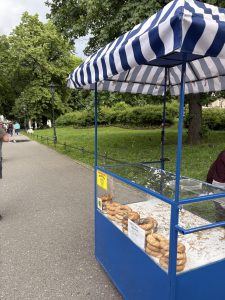
Obwarzanek stands in Krakow
It is impossible not to notice braided obwarzanek krakowski in the “city of kings” which Krakow is known for. You can find it in the little blue-and-white stalls with different traditional toppings but keep in mind it should be sesame, salt or poppy seeds, if you decide to mix it it’s not going to be a traditional obwarzanek.
Marta Krzyżek-Siudak is the CEO & Founder of Muzeum of Obwarzanek in Krakow where you can learn about the traditional obwarzanek’s history, bake it yourself and most importantly eat it. And if you do it well, be sure you will get a certificate and make your parents proud.
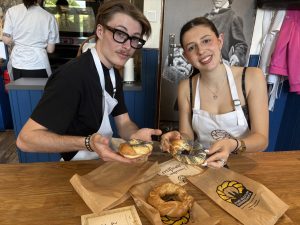
Participants made obwarzanki in the Museum
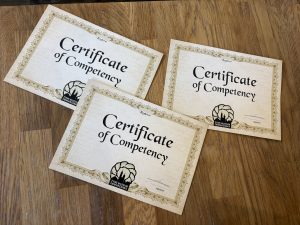
Certificates of Competency given by the Museum of Obwarzanek
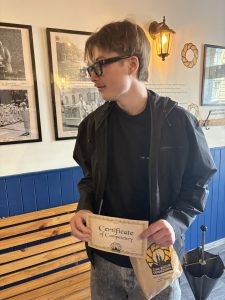
Participant with a certificate
When you look at obwarzanek you can’t guess the earliest known mention appears in royal court accounts from 1394, where Queen Jadwiga purchased obwarzanki for the royal household.
What is the meaning of obwarzanek you may or may not ask yourself. The Polish word obwarzać means “to parboil,” which refers to the traditional method of boiling the dough before baking. Put your braided obwarzanek in boiling water and count from 1 to 10 or from 10 to 1. Well, personally I preferred the first method.
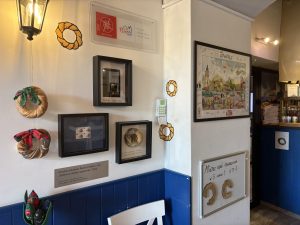
The Museum of Obwarzanek
Obwarzanek’s importance extends beyond baking traditions. In 2010, the European Union granted obwarzanek krakowski Protected Geographical Indication (PGI) status, meaning that only bread produced in a specific area using traditional methods can legally bear the name.
“When the European Union granted obwarzanek krakowski PGI status back in 2010, it basically gave it a legal shield,” Krzyżek-Siudak explained. “It means nobody can just copy it. To legally use the name, it must be made in a specific area using strictly traditional methods. This doesn’t just protect the recipe, it keeps the authentic cultural heritage alive and stops counterfeit versions from watering down the tradition.”
The story of obwarzanek is also a story of trade. Its ingredients connected Kraków to wider commercial networks that linked cities across medieval Europe. Salt, one of the bread’s traditional toppings, was among the most valuable commodities of the period. The nearby mines of Wieliczka and Bochnia helped make Kraków a major centre of the salt trade, supplying markets across Central and Eastern Europe.
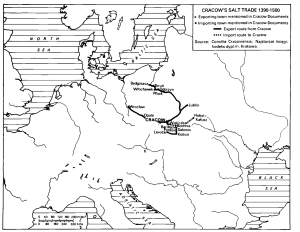
Salt is one of the main traditional toppings of Obwarzanek. Krakow’s salt trade 1390-1500. Source: Consilia Cracoviensis; Najstarsze Ksiegi kodeks dypl.m.Krakowa.
These trade routes eventually intersected with the Hanseatic world. Although Kraków was never a Hanseatic city, it maintained strong commercial connections with Hanseatic ports such as Gdańsk. Northern Poland relied heavily on French salt distributed through Hanseatic trading networks, while goods from inland regions passed through Baltic ports before reaching international markets.
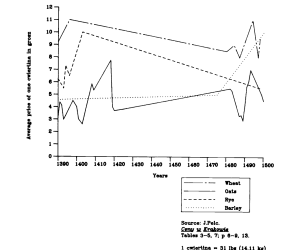
Price of cereals in kracow, 1390- 1500 Source : J. Pelc. Ceny w Krakowie
Grain, another essential ingredient in obwarzanek, followed similar routes. During the fourteenth and fifteenth centuries, grain became one of Poland’s most important export commodities. Surplus grain from Lesser Poland travelled through Toruń to Gdańsk, where it entered the broader Baltic trade system dominated by Hanseatic merchants.
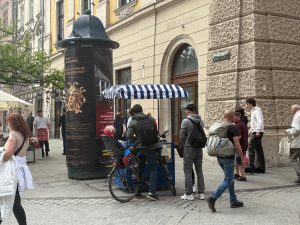
People buying obwarzanek at Kraków’s Main Market Square (Rynek Główny)
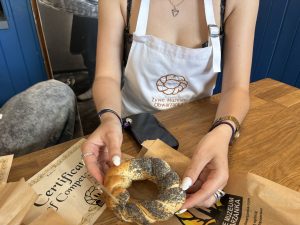
Obwarzanek with poppy seeds
Today, most people buy obwarzanek as a quick snack while exploring Kraków’s historic streets. Yet every braided ring carries traces of a much larger story—one that connects royal courts, salt mines, grain merchants, and the medieval trade routes that linked Kraków to the Hanseatic world.