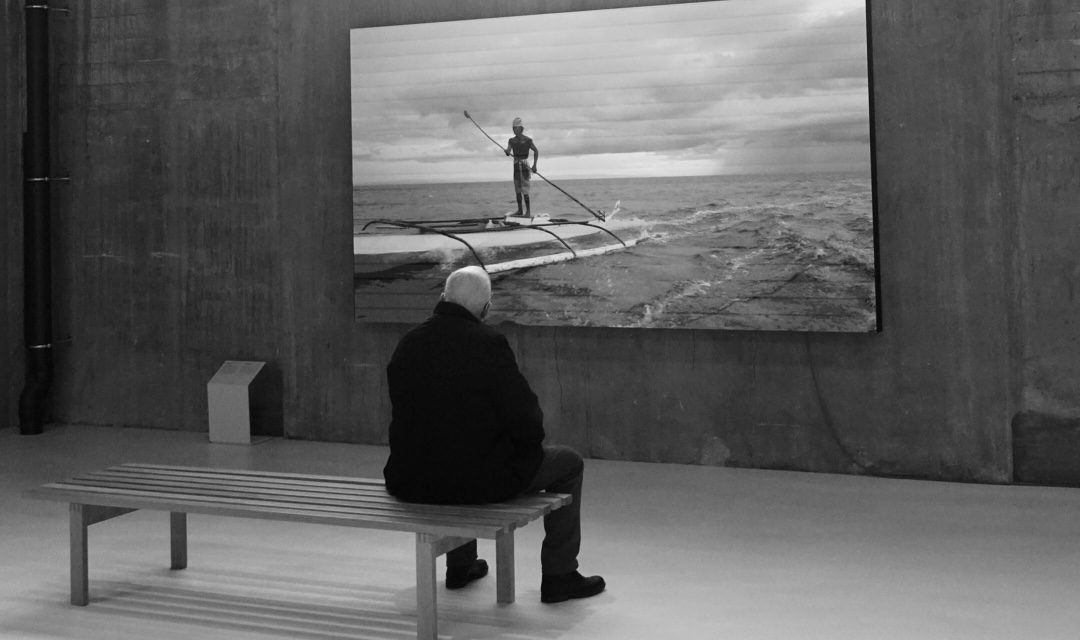
Since the beginning of February, the Netherlands has seen a wave of anti-migration protests. In Nieuw-Lekkerland, residents opposed plans to host asylum seekers. In Volgewijk (The Hague), demonstrators gathered outside a former Red Cross hospital, while in Bleskensgraaf, tensions turned into a riot that required police intervention. As migration continues to divide public opinion across the Netherlands, Rotterdam’s Fenix Museum offers a different perspective. Through its exhibition All Directions: Art That Moves You, the museum explores migration through personal stories, art, and identity rather than political debate.
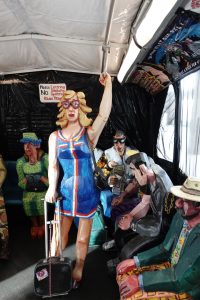
Red Grooms’ life-sized The Bus installation turns a crowded city bus into a playful yet pointed metaphor for shared movement and migration. Photograph by Kim Elst, 2026.
Art That Moves You
Rotterdam’s Fenix Museum offers this perspective through its exhibition All Directions: Art That Moves You. Featuring over 150 works, the show explores migration through art, identity, borders, home, and displacement.
Red Grooms’ The Bus, for example, turns an ordinary city bus into a vibrant scene of imagined passengers, inviting visitors to see migration as human connection and movement rather than abstract numbers. Across paintings, sculptures, video, and installations, many pieces include personal stories of migrants, allowing the viewer to step into someone else’s journey. The exhibition blends emotion, history, and visual storytelling to show migration as a deeply human experience.
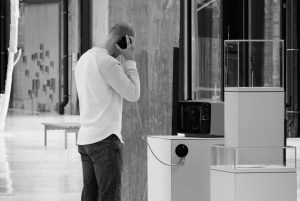
Listening to a Migration Story. A visitor listens to a recorded migrant story within the exhibition, emphasizing the personal voices behind broader migration debates. Photograph by Kim Elst, 2026.
From Statistics to Personal Stories
Abdelkader Benali, writer and curator of Fenix Museum, who moved from Morocco to Rotterdam as a child, emphasizes the need to humanize migration. “Figures and policy create an abstract image behind which the migrant disappears rather than emerges. Migration is deeply a personal story; there is not one ‘typical’ migrant.”
Carolus Grütters, Research Fellow at the Centre for Migration Law (CMR) at Radboud University Nijmegen, adds: “The phenomenon of migration is something different from the migrant. Migration simply means that someone crosses a border to live somewhere else. That makes you a migrant.” By focusing on love, travel, life, and death, the exhibition shifts attention from legal definitions to shared human experiences.
A Reluctant History in a Port of Change
The museum itself, perched on historic docks, is a reminder that the Netherlands has always been shaped by movement. A century ago, Europeans left these docks for North America, and early Dutch law was surprisingly open: “One of the earliest Dutch constitutions said that anyone who was persecuted could come here to find rest” says Grütters. Yet this openness often came with pragmatism: “The attitude has always been similar: nice enough but we shouldn’t be burdened. Foreigners are welcome as long as we can earn money from them.”
This tension has long been observed by migration scholars. Sociologist Jan Rath of the University of Amsterdam describes the Netherlands as a ‘reluctant country of immigration’, arguing that Dutch society has historically depended on migration while remaining hesitant to see itself as an immigration country. We still see this today, as debates over asylum and new reception centres spark protests and tensions across the country. Therefore, Fenix’s mission is to frame migration not as a modern crisis but as a timeless, universal feature of Dutch society.
Curiosity Over Conflict
Benali believes cultural spaces can reshape perspectives: “We hope especially to stimulate the conversation and to reach the youth, because they are also looking for the stories of their ancestors.”
Yet Fenix has not escaped criticism itself. Some commentators and visitors have questioned whether the museum presents migration too positively and whether it gives enough attention to the political tensions and social concerns surrounding the issue. The debate reflects the wider disagreement in Dutch society about how migration should be understood and discussed.
Grütters adds that fear often comes from unfamiliarity: “If someone suddenly appears who is very different, people find it strange. But after a while, when they see that person every day, it becomes normal.”
Migration scholar Hein de Haas, Professor of Sociology at the University of Amsterdam, similarly argues that public debates about migration are often shaped more by perceptions and political narratives than by migration realities. All Directions offers another perspective, showing migration as part of everyday life and identity for both newcomers and Dutch society. By replacing generalizations with personal stories, the exhibition encourages empathy over fear and curiosity over judgment, reminding visitors that at its heart, migration is about people and their dreams, struggles, and connections across generations.