For the first time in 10 years there is a rise in religious people in the Netherlands. That is not enough to call it a break in trend, but it is a good reason to take a closer look – especially at religion among young people and new forms of church.
While the Netherlands is one of the happiest countries of the world, religion plays only a very minor role for the Dutch compared to other European countries. Jan Loffeld, professor of practical theology at the Tilburg School of Catholic Theology in Utrecht even calls the Netherlands the “vanguard of secularization”; the rupture with religion as a cultural force already happened in the 1960s. In 2024, 56 percent of the Dutch are non-religious. For comparison: in Germany it was 47 percent.
However, there is one religious movement that is becoming more and more popular, especially among young people. These are new, more “modern” forms of evangelical churches, originating in the megachurches of the United States, which by now also have reached Europe and the Netherlands. In Utrecht, one example would be the Best Life Church.
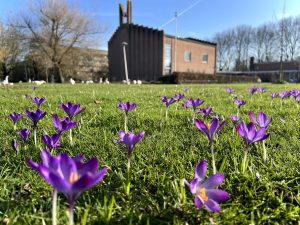
among young Dutch people, believe in God is growing again. By Noa Rodler-Bork
“It fits more in our society nowadays”
Anisia de Kok, a 23-year-old student from Utrecht discovered the Best Life Church one christmas evening, while searching for a modern church with a big and diverse community. “The people there spoke to me right away, which was nice.” In comparison with traditional churches, she liked “the informality, the easiness, it’s not that harsh and more real. For example, they do show that people are struggling.”
A central part of the service at the Best Life Church is worship. De Kok explains that most of the service consists of the community singing songs – usually arranged in a modern style – together to praise God. It is to mention that De Kok only visited the Best Life Church this one Christmas evening. The Best Life Church decided not to speak to the author of this article.
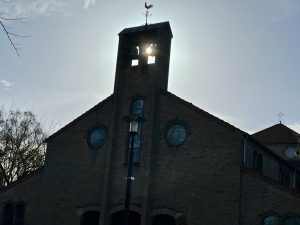
for young people, religion can be a light of hope shining in the dark. By Noa Rodler-Bork
Gen Z’s search for identity in religion
The renowned theology professor and author Jan Loffeld observes a new neutrality towards religion among the Gen Z: “At least here we see a new openness to the transcendent.” According to Loffeld, the key factor that makes religion so interesting for young people is the search for identity. Religious institutions know what they stand for, and that is often appealing to young people.
In fact, the Global Flourishing Study shows that people who attend religious services regularly are statistically less likely to struggle with depression, heavy drinking, and all-cause mortality. Religion can give people meaning in life, thereby supporting their mental health.
Progressive look, conservative core?
On social media, megachurches often present themselves as modern and open to everyone. But to think that megachurches are suddenly extremely progressive would be a false assumption. “It’s a church, so it is going to be conservative in any way. It’s not like they openly accept LGBTQ+ people,” says Anisia de Kok.
According to Jan Loffeld, their large presence on social media is one of the reasons behind the megachurch hype. However, when it comes to the “hype”, Loffeld cautions that the online appearance can be misleading. “They don’t actually have that much attendance. What they have is a good performance that makes it look like they do.”
The fact is that 15- to 18-year-olds in the Netherlands are more religious than those aged 18 to 35. If that marks the begin of a long-term religious shift in Europe and if the new spirituality even relies on churches anymore, can be doubted. Anisia de Kok: „I don’t think you really need a church to go to to have a relationship with God.”