The Dolle Minas are a feminist group from the Netherlands that resurfaced at the beginning of 2025. Now, as they prepare for International Women’s Day on March 8, two different generations are sitting around the tables. Those who experienced the Dolle Minas back in the day, and those who learned about them in school. Why did they join the group now and what has allowed the group to create such a lasting generational impact?
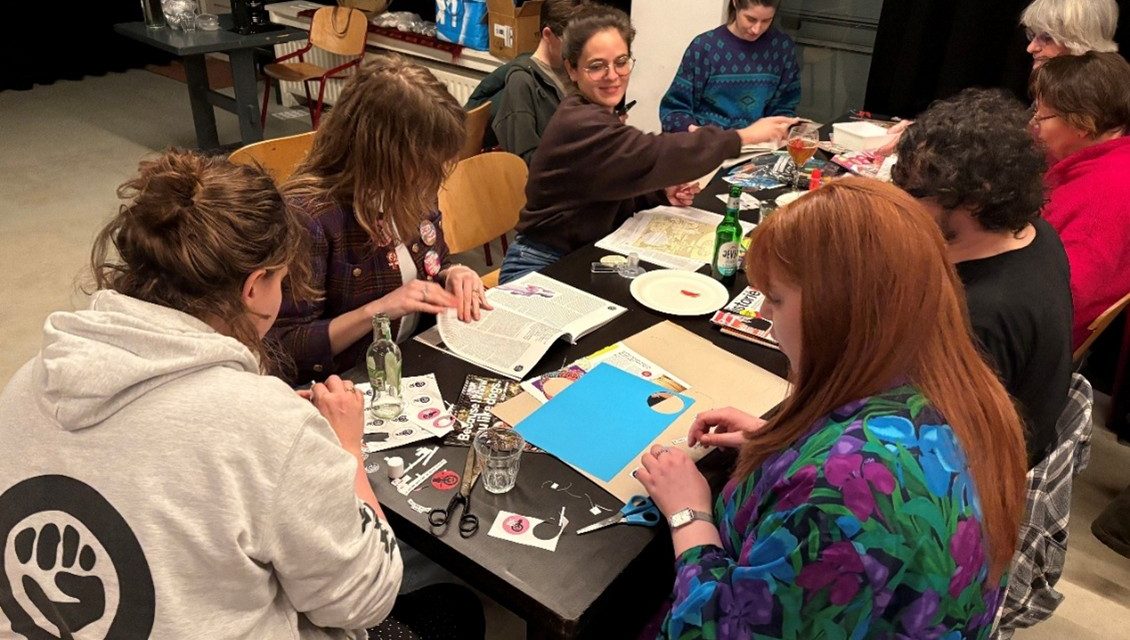
Inside a cultural center in Utrecht one can smell the scent of watercolors and markers. Tables are covered with scissors, colorful palettes and unfinished posters. In every corner of the room people sit together, chatting and sharing their ideas for the evening. Almost every week now the Dolle Minas are organizing an evening to get together across the Netherlands.
The Revival of the Dolle Minas
The movement’s history began 55 years ago. According to the archives of Atria Institute Amsterdam, the Dolle Minas first appeared on January 23, 1970. A small group of fifteen women and five men occupied an economics college building near Utrecht that excluded female students. From there the Dolle Minas grew and became one of the most recognizable feminist voices in the country.
While the movement began with just 20 people, its 2025 revival, led by organizers like Jet, has seen an explosion of interest. “The first meetings were in May”, Jet explains. “By August, we had a meeting where more than 100 people came. The room isn’t even built for that many people, so they had to queue outside.”
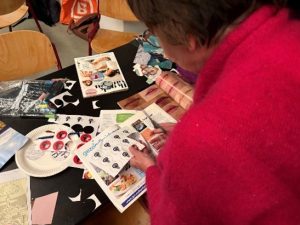
Surrounded by magazines, member Agaath cuts out feminist symbols to make buttons.
Two generations, one table
At the crafting tables, the generational impact becomes visible through the participants. Fleur recently finished her university studies and now works in medical science research. She first learned about the Dolle Minas in history class, but seeing them in person is different. The exchange between many generations fascinates her. “I came here alone, but I already met so many new people,” she says.
At the table across sits Agaath, an older woman who has been part of the Dolle Minas since the 1970s. She spent twenty years working for a company that supported the group’s mission. Agaath rediscovered the group through the global campaign “Stitches Against Violence,” where women knit and crochet to send a message about safety. Now attending her second meeting of the revival, she feels energized by the younger generation’s fresh ideas. “It is great to see so many people wanting to make an impact again,” Agaath says.
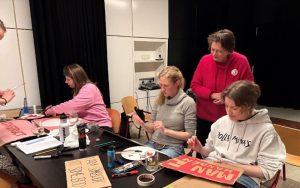
Looking for inspiration: Agaath (back) observes the younger generation’s ideas during the workshop
The need to fight back
Fleur and Agaath joined the group for the same reason. Both see that women still face fundamental problems regarding safety and equality. Even though the world has changed since the 1970s, progress is still too slow for the Dolle Minas. According to the Gender Equality Index in 2025, 41% of women in the Netherlands have experienced harassment and physical violence since the age of 15.
The Dolle Minas answer this need to fight back by offering a real-life community. By organizing diverse events ranging from workshops to film screenings, they attract a crowd that bridges the gap between the past and the future. For group members like Agaath and Fleur, the movement connects people who fought in the 1970s with those discovering feminism today.
As the evening comes to an end, the posters are finished and everyone tidies up their tables, one thing is certain: The Dolle Minas have created a generational impact by showing that feminism belongs to everyone.