Inside a small bar in Berlin called Kapitalist, beers keep arriving at the table as riders come and go, greeting each other like it is home. This is more than just a bar. It is the unofficial headquarters of Basis Berlin, a scooter crew that has become a meeting point for riders from across Europe and beyond.
In recent years, Berlin has emerged as one of the most influential cities in European freestyle scootering. Unlike many local scenes that revolve around a small group of riders, the German capital attracts visitors from different countries who come to ride, film and exchange ideas. At the centre of this network stands Basis Berlin, a collective whose open-door philosophy has helped transform the city into an international hub for scooter culture.
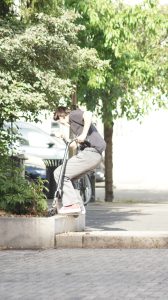
Sitting among them is Jonatán Lőrincz, a rider and filmmaker who has been part of the project since its early days. Between sips of beer, he describes a scene built on an open mind, where international riders regularly pass through, bringing their own style and ideas to the Berlin street culture.
For Jonatán Lőrincz, Basis Berlin is not just a crew, it is a way of living and sharing a culture. What started as a small group of riders in Berlin has gradually turned into a meeting point for freestyle scooter riders from all over the world.
“The idea is simple,” he explains. “It’s like an open door. Anyone can come, stay, ride, film just be part of it.” This openness is at the core of Basis Berlin. Rather than focusing only on performance or competition, the collective is built around exchange, creativity and community.
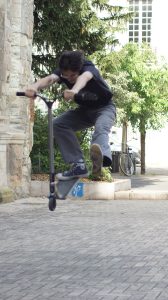
Since its early days, the group has welcomed a constant flow of international riders. Some come for a few days, others stay longer, often sleeping in the same apartment, filming together and exploring the city. These encounters create a unique dynamic, where different styles and influences mix. “People bring their own vision,” Lőrincz says. “And that changes how you see riding.”
This global dimension is also shaped by travel. Members of Basis Berlin regularly move across Europe and beyond, connecting with other scenes and building relationships. For Lőrincz, one of the most important experiences was a trip to the United States, where he met riders like Reece Doezema, Parish Isaac and Juzzy Carter. “Meeting people from different places really motivates you,” he explains. “You see new things, new ways of riding, and it pushes you.”
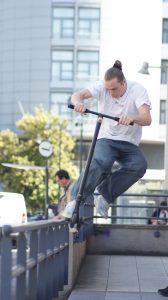
These connections are not only about riding, but also about creating. Filming plays a central role in the identity of Basis Berlin. Videos are a way to document sessions, but also to express a certain vision of scootering. “Filming is probably 50% of a clip,” Lőrincz says. “It’s not just about the trick, it’s about the feeling.” Through editing, music and visual style, the crew builds a narrative that goes beyond performance.
It reflects a broader underground culture. Unlike more commercialized sports, freestyle scootering remains a relatively small scene, with limited financial support. For Lőrincz, this is not necessarily a disadvantage. “There is not a lot of money in scootering,” he says. “But that’s why people are real. It’s easier to connect.” In this context, crews like Basis Berlin become important spaces for collaboration and authenticity.

Berlin itself plays a key role in this dynamic. The city may not offer the most obvious or perfect riding spots, but it provides something else: freedom and openness. “It’s a very open-minded city,” Lőrincz explains. “People are welcoming, especially for new riders.” This atmosphere encourages experimentation and makes it easier for newcomers to integrate into the scene.
At the same time, the physical environment of the city its raw architecture, unexpected spots and imperfections fits perfectly with the crew’s approach to street riding. Instead of looking for ideal conditions, riders adapt to what they find, turning ordinary places into creative playgrounds.
In this context, Basis Berlin stands as more than just a local group. It represents a network, constantly evolving through encounters, travels and shared experiences. By keeping its “door” open, the crew continues to connect riders across borders, shaping a scene that is as much about people as it is about riding.