In Berlin, the boundary between art and technology is slowly dissolving. A growing number of artists are experimenting with digital systems, sound, and immersive installations, not as a threat, but as a new artistic language. What used to be a niche practice has evolved into a more accessible field, spanning both physical spaces and online environments.
Wolf Lieser, founder of DAM Projects (formerly the Digital Art Museum), has been part of this development for more than 30 years. When he first encountered digital art in the late 1980s, the field was still very undefined. “It was totally new,” he recalls. “I thought, what is this? Why doesn’t it exist? As a young person, it felt like a good way to position yourself with something different, instead of showing the usual painting like everyone else.”
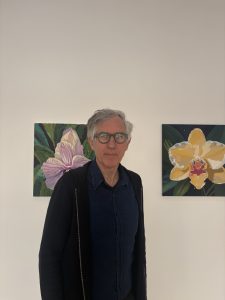
Photo: Femke Eelderink
At the time, opportunities to engage with digital art were very limited. Lieser mentions early events like Ars Electronica and SIGGRAPH as rare meeting points for pioneers. Since then, the field has expanded in a broad way. “These locations are not that important anymore,” he says. “Now we have a very broad field of digital art.”
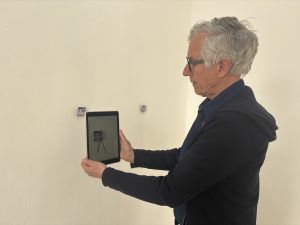
Wolf Lieser shows how the artwork of Lauren Moffatt is digitally expanded with holding an Ipad in front of it. Photo: Femke Eelderink
That evolution is reflected in DAM Projects’ current exhibition code+paint, featuring artists Liat Grayver, Gretta Louw and Lauren Moffatt. In their work, coded systems and robotics are the main focus. Machines attempt to replicate painted artworks, or extend them into digital environments, making the line between human made and algorithmic processes less visible.
For Lieser, selecting artists is not just about innovation, but also about personal taste. “You need to connect to this kind of art somehow,” he explains. “If you find it boring or it doesn’t convince you, it’s very difficult to sell.” At the same time, he looks for artists with a certain consistency: “People who have developed a career and show continuity in the field.”
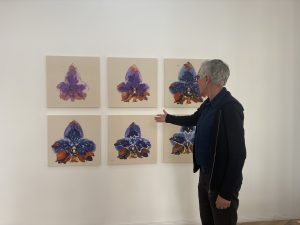
Lieser shows the artworks by Gretta Louw. Photo: Femke Eelderink
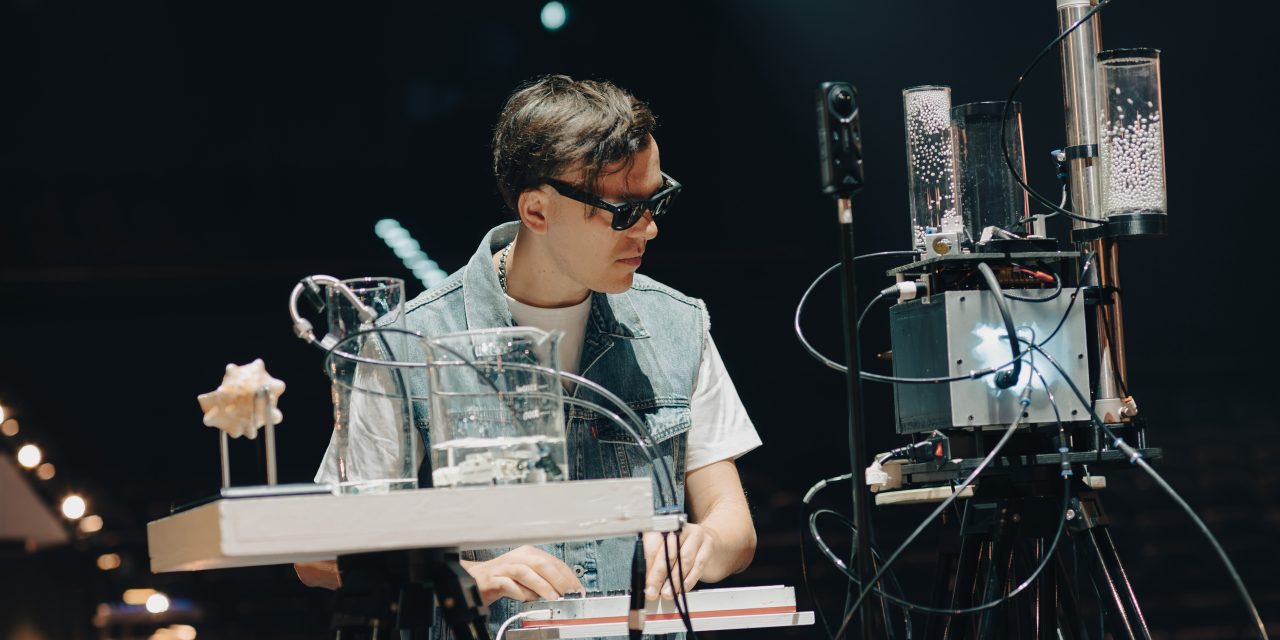
Where Lieser focuses on curating digital art, artist and robotics engineer Moritz Simon Geist approaches it from a performative angle. For over 15 years, he has been working at the intersection of sound, robotics, and physical systems. His installations often transform everyday objects, for example shells or popcorn, into instruments.
“My niche is to find small sounds in everyday objects and bridge them with real-world kinetics,” he says. “It’s about connecting the digital and the physical world.”
Geist’s background in classical music continues to shape his work. He played clarinet and guitar and sung in a church choir, where he developed a strong awareness of how sound is physically produced. “When a violin is struck, you can see where the sound is coming from,” he explains. “I wanted to apply that to electronic music, so that these sounds are produced by small devices you can touch, see, and even smell when things are burning or crashing.”
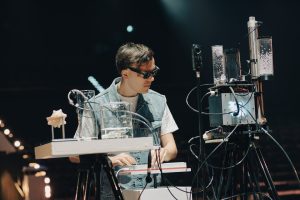
Photo: Carl Anher
His work stands in contrast to more opaque forms of digital production. “If someone is on stage with a laptop, you don’t know what they are doing, they could be checking their emails,” he says. By making sound production visible and tangible, he aims to reconnect audiences with the physical reality behind digital media, and give them a experience which they can use all their senses for.
This emphasis on materiality challenges a common misconception about digital art. “It’s a misunderstanding that digital art isn’t physical,” Geist argues. “Behind every digital medium there is something very concrete, a computer, hardware, mechanics.”
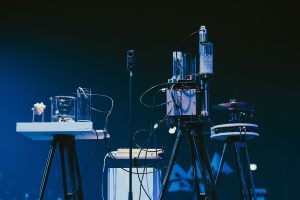
Photo: Carl Anher
That physical dimension is becoming increasingly relevant in a time when digital content is often consumed in fleeting moments. Platforms like Instagram have changed how audiences engage with art. “You have maybe 15 seconds,” Lieser says. “If it convinces you in that time, you might look a bit longer, but it has definitely changed how we experience art.”
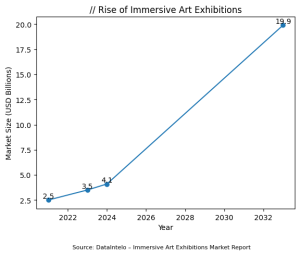
At the same time, digital art is reaching wider audiences through immersive exhibitions and online platforms. Large-scale projection spaces and interactive environments, particularly popular in cities like Berlin, have emerged as part of contemporary culture. They attract visitors who might never set foot in more traditional institutions.
Source: Dataintelo
Yet both Lieser and Geist stress the importance of maintaining artistic independence within this rapidly evolving landscape. Geist, who now works with a team of twelve, sees this as essential: “Art should always strive to be independent from large business networks and their models.”
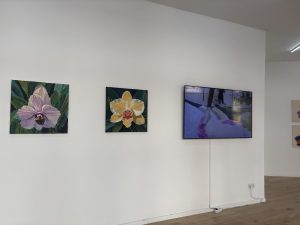
Photo: Femke Eelderink
For him, the future of digital art lies in keeping it grounded in the real world. “It’s absolutely necessary to have real-world artistic applications,” he says. “There are so many artists working in this space, keeping digitalization alive while tying it back to something physical, for example through robotics in music. So you can actually see what’s going on, instead of just clicking a button and getting a fully rendered track.”
In Berlin’s digital art scene, code is no longer abstract. It moves, sounds, and sometimes even burns, making the invisible visible, and the intangible tangible.