If you spend a bit of time in Berlin, you start noticing how normal tattoos have become. On the U-Bahn, in cafés, or sitting in a park, it feels like almost everyone has at least one. Some are small and hidden, others impossible to miss. They have become part of the city’s image. But that was not always the case.
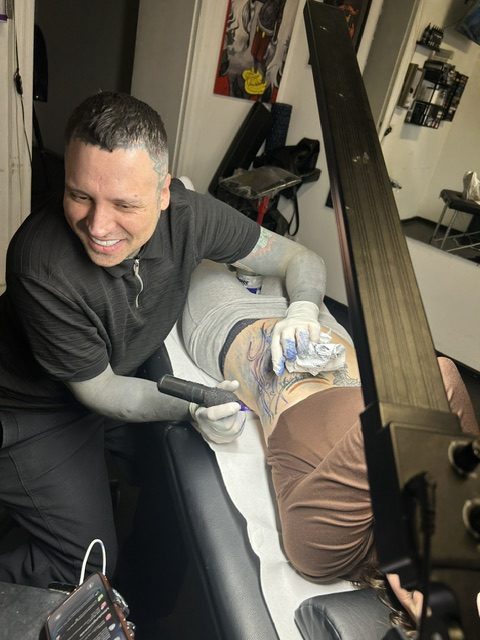
Martin Page, a tattoo artist who has been working in his own studio since 2009, has seen this shift happen over the years. He got into tattooing through friends from the skater scene, where tattoos used to be closely tied to a certain lifestyle. “Back then, it was something special,” he says. “Not everyone had one.” His clients looked very different as well. “I used to have more people from the skater scene,” he explains. “Or you could say, people who had spent a few years in prison.” In those circles, tattoos meant something. They showed where you belonged and what you stood for. Now tattoos are no longer tied to one specific group. According to Martin, they have become part of everyday life. “Now everyone gets tattoos,” he says. And that is not an exaggeration. People from completely different backgrounds walk into his studio: students, office workers, people in their thirties or forties, and even very young clients.
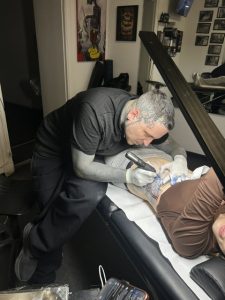
Martin Page in his tattoo studio
The change is also visible in where people choose to get tattooed. Years ago, tattoos were often placed in areas that could easily be hidden. Today, it is almost the opposite. Hands, neck, and sometimes even the face are chosen without much hesitation.
Furthermore the reasons behind tattoos have shifted. Martin explains that it used to be more about standing out or being rebellious. That element still exists, but it is no longer the main focus. Many people today care more about the aesthetic side. They want something that looks good, something that fits their personal style. Social media plays a major role in this development. Trends move quickly, and people often come in with very specific ideas they have seen online. Martin compares it to fashion. “There are always a few things that suddenly everyone wants,” he says. At the moment, for example, lettering along the spine is extremely popular.
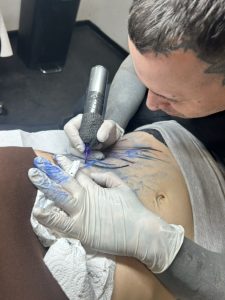
Berlin itself adds another layer to this. The city is constantly changing, with people moving in from all over the world. That also shapes tattoo culture. “You can find every style here,” Martin says. Traditional, fine line, realism, or more experimental work all exist side by side. This kind of variety was not always present in the same way. It has grown together with the city.
At the same time, tattoos are starting to appear in new contexts beyond the studio. In Berlin, projects are emerging that present tattooing in public and digital spaces. One example is a museum initiative by George Mihai Vasilescu, which aims to make tattoo culture more visible as a contemporary art form.
“The idea started from a simple thought,” George explains. “Tattooing has evolved a lot, but it is still rarely presented clearly as contemporary art.” Instead of a traditional museum that people enter, the project uses an augmented reality installation in the city. Each week, a different tattoo artist is featured on a digital cube in Lustgarten, allowing anyone passing by to experience the work directly in public space. The project also exists online, where the artworks can be collected digitally. “The goal is to show how the medium is changing and to give artists more visibility,” George says. In this way, tattooing is not only seen on the body, but also as something that can exist in a wider cultural context.
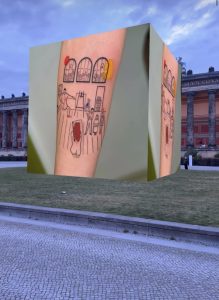
AR cube in Lustgarten
However, this development also has its downsides. Martin notices that the more common tattoos become, the more casually some people treat them. “Some see it like a haircut,” he says. They choose something because it is trendy, and a few months later they regret it. As a result, cover-ups have become more frequent.
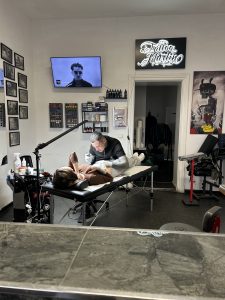
Still, it is difficult to ignore how much things have changed. Tattoos have moved from something connected to subcultures or even criminal stereotypes to something completely normal. Especially in Berlin, where self-expression is part of everyday life, that change is clearly visible. What once stood out now blends into the crowd. And that might be the most interesting part. Tattoos have not lost their meaning, but they have changed their place in society. They are no longer only a symbol of rebellion, but something that almost anyone can make part of their identity.