When walking through the city of Utrecht you’ve probably encountered other students, a lot of tourists and most likely seen more bikes than people. However, when returning home for the day, you may have noticed something: There aren’t a lot of persons who are visibly over the age of 60, if any. That could not have been possible in my hometown of Stuttgart, Germany, where I’ve noticed they are a permanent part of the cityscape. So, this raises the question: Are there no older people in Utrecht?
That obviously can’t be right, so let’s have a look at the data:
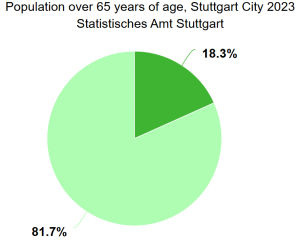
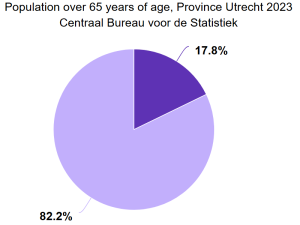
Apparently, both Utrecht and Stuttgart have nearly identical shares of an elderly population, but they seem to differ immensely in their street-visibility. Why is that?
“They rather stay in their homes.”
Someone who might have an answer is Yvon Hoogendijk, a local expert who works with older residents every day. She’s the director of “U op leeftijd”, a foundation funded by the municipality of Utrecht with the goal of representing older people’s wants and needs in public discussions. According to her, there are two main issues keeping them out of the city center, the first one being residential patterns: Many older residents live in neighborhoods surrounding the center and not in the inner city, as these spaces are commonly occupied by students and younger professionals. Due to this, their daily life and societal environment are mainly based in their own neighborhoods; a change that’s amplified by the rise of digitalization. Contrary to popular belief, Hoogendijk states that people over the age of 65 frequently use the internet to take care of shopping and make appointments from home. They simply don’t need to go to the inner city for their errands, which probably explains my different experiences from Stuttgart and Utrecht. (In Germany, a lot of older people won’t use the internet at all; they’d rather go to the center to take care of their everyday tasks in person.)

“The city center is moving at a high pace.”
Hoogendijk’s second (and main) reason for people to stay in their neighborhood is the lack of accessibility in public spaces. As Utrecht identifies as a bicycle city, it’s no wonder that two-wheelers are prioritized by city planning. This sounds good at first, being environmentally friendly and saving space compared to cars, but Hoogendijk reports that older residents have problems with the fast-moving bicycle traffic. Combined with crowded streets and some people’s disregard for traffic rules, this creates a lot of stress and a feeling of insecurity for some older people. It’s no surprise then that many elderly people prefer walking to cycling. That however, comes with its own set of challenges like narrow pavements, obstructions or poor maintenance, particularly affecting people relying on walking aids or wheelchairs.
When asked about a possible solution to these problems, Hoogendijk proposes a change of the city’s focus from cyclists to pedestrians, which could help some older people regain a sense of security in the center. But she also thinks that even with improvements to public spaces, most older residents will probably prefer their own neighborhoods to the busy city center.
So no, the elderly residents of Utrecht are not missing, they just live in surrounding areas and refuse to navigate a crowded city center that is not designed for them. Maybe the real question is not where the old people are, but who our cities are designed for and who they make visible.