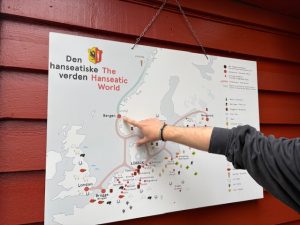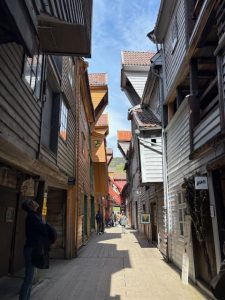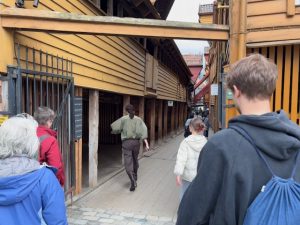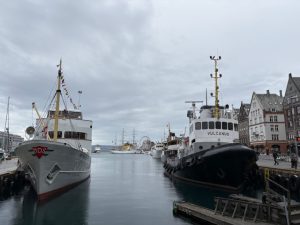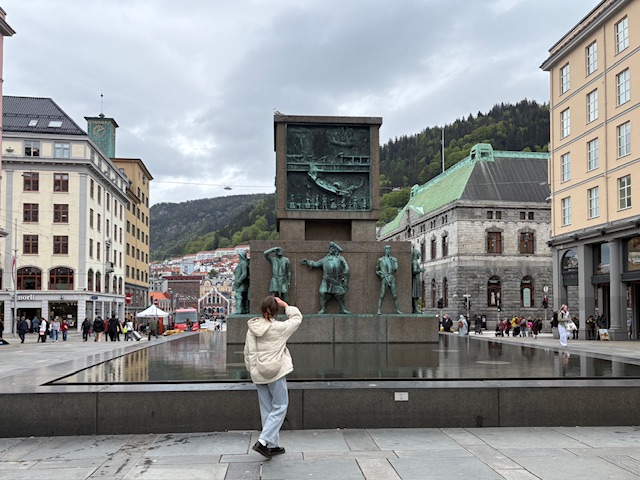
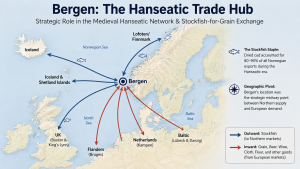
For the German merchants living in Bergen, prosperity arrived by ship. From the Hanseatic Kontor on the city’s waterfront, stockfish was exported across northern Europe. Merchants depended on a network of maritime routes stretching from Norway to ports around the North and Baltic Seas. As long as ships kept moving, business flourished. But what happened when those routes became targets?
Who Were the Vitalienbrüder?
In 1393, Bergen was attacked by the so called Vitalienbrüder. The raid is often remembered as an episode of medieval piracy. Yet according to historians the story is more complicated.Professor Dr. Gregor Rohmann, a German historian, is researching the classification of the group. “The popular image of the Vitalienbrüder is that of some kind of pirate gang or pirate company that emerged during a war,” he explains. However Rohmann suggest that the group was less organized than the legends imply.
The Attack on Bergen
When the Vitalienbrüder attacked Bergen in 1393, the city became caught up in a larger political struggle between the Mecklenburg dukes and the Danish crown. Houses were looted, parts of the city were damaged and trade was disrupted.
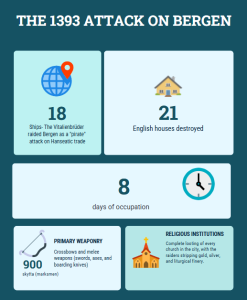
At first glance, it sounds like a typical pirate attack. But according to Rohmann, the situation was much more complex. The attack was not primarily directed against the German merchants living in Bergen. In fact, the attackers appear to have deliberately spared the Hanseatic Kontor in order to avoid conflict with the Hanseatic cities. Even though the merchants were not directly targeted, they still felt the consequences. Bergen’s prosperity depended on maritime trade, especially the export of stockfish across northern Europe. Once shipping routes became unsafe, trade quickly suffered.
As a result, Hanseatic cities were forced to suspend trade for an entire season because the route had effectively become unusable. For merchants, this meant uncertainty and financial losses. The attack on Bergen therefore reveals more than a single episode of violence. It highlights how closely trade and politics were connected in the late Middle Ages. “There is a political calculation behind it,” Rohmann says. By attacking important ports, rulers could put pressure on their opponents and pursue political goals. For the German merchants living in Bergen, that was the real danger. Their wealth relied on connections stretching across the North and Baltic Seas, yet those connections could be interrupted at any moment by conflicts far beyond their control.
And today?
Modern economies are still dependent on maritime trade routes. According to UNCTAD around 80 percent of global trade by volume is transported by sea. Recent tensions in the Red Sea and attacks on commercial vessels have shown how quickly global trade can be interrupted when strategic waterways become part of political conflicts. Although more than six hundred years have passed, Rohmann can still see parallels between the medieval time and the present. Political instability and contested trade routes are not uniquely modern problems. In many ways, the challenges faced by Hanseatic merchants in Bergen resemble the challenges facing global trade today.