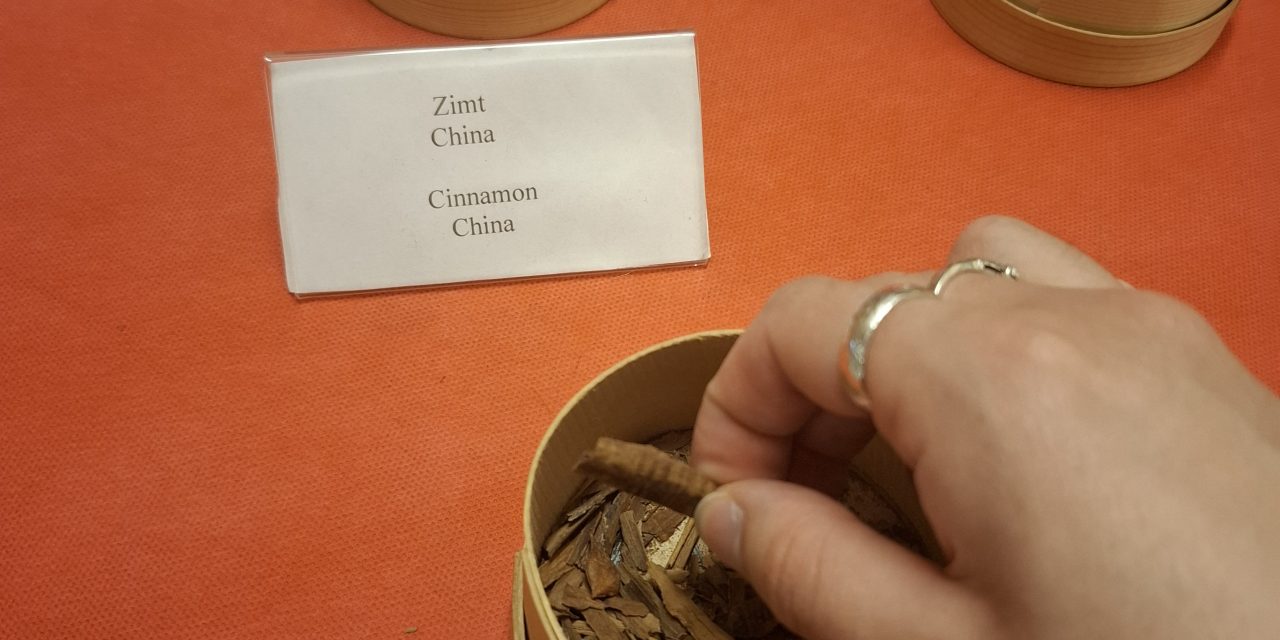
Cinnamon is one of the most loved spices in the world with many people associating it with happy memories such as sipping on mulled wine at Christmas time or the sweet smell of a freshly baked apple tart. However, cinnamon is much more than just a flavouring for cakes and sweet treats.
Cinnamon originates from Southeast Asia. It comes ‘from two tree species Canehl [Ceylon] and Cassia. Cassia is cultivated in Vietnam, Indonesia, and Japan, whereas Canehl grows in Sri Lanka and Madagascar. Canehl and Cassia are the inner barks of the trees which is peeled off every six years,’ explains the Spicy’s Gewürzmuseum in Hamburg website.
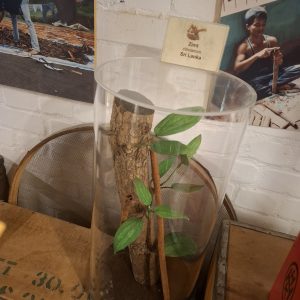
Display of Canehl tree at Spicy’s Gewürzmuseum in Hamburg
While many people see cinnamon simply as a sweet-smelling spice that enhances the flavours of their baking, it actually has many health benefits. The German Commission E, a scientific advisory board of the German Federal Institute for Drugs and Medical devices, recognises cinnamon as an official remedy. The remedial uses of cinnamon bark were listed in the ‘The Complete German Commission E Monographs,’ published in 1990, as ‘For loss of appetite, dyspeptic [digestive] complaints such as mild, spastic condition of the gastrointestinal tract, bloating, and flatulence.’
Along with its health benefits, cinnamon has also shaped many culinary traditions, especially in Germany. In the former Hanseatic city of Hamburg, cinnamon is a popular ingredient for many bakers as it is the main flavour of Franzbrötchen, a “cult” classic pastry from the region. The Hanseatic League was a trade league, which connected countries such as the Netherlands, Germany, Norway, Denmark, and Poland. Hamburg joined the Hanseatic League in 1358, at this point the city had extensive trade connections across the globe, including London and Scandinavia. Come the end of the 18th century and the decline of the Hanseatic League, Hamburg had developed trade routes to Asia and the Americas. This allowed the city to become the third largest trade centre for spices in the world. Unlike other products, like coffee, grain, and timber, which were mass imported into Hamburg, cinnamon was ‘handled more delicately’ explained a tour guide at the Deutsches Hafenmuseum [German Port Museum] in Hamburg.
[aesop_content color=”#ffffff” background=”#8ab7ff” columns=”1″ position=”none” imgrepeat=”no-repeat” disable_bgshading=”off” floaterposition=”center” floaterdirection=”up” revealfx=”off” overlay_revealfx=”off” aesop-generator-content=”Hamburg Trade Routes
</p>
<div class="flourish-embed flourish-map" data-src="visualisation/29275867"><p><img src="data:image/gif;base64,R0lGODlhAQABAIAAAAAAAP///yH5BAEAAAAALAAAAAABAAEAAAIBRAA7" data-wp-preserve="%3Cscript%20src%3D%22https%3A%2F%2Fpublic.flourish.studio%2Fresources%2Fembed.js%22%3E%3C%2Fscript%3E" data-mce-resize="false" data-mce-placeholder="1" class="mce-object mce-object-script" width="20" height="20" alt="<script>" /><noscript><img src="https://public.flourish.studio/visualisation/29275867/thumbnail" width="100%" alt="map visualization" /><span id="mce_marker" data-mce-type="bookmark" data-mce-fragment="1"></span></noscript>”]Hamburg Trade Routes
[/aesop_content]
Shed 50A, which was once at the heart of the city’s free port now documents the history of the port of Hamburg though its extensive collection of artifacts. The museum has ‘original, sealed samples’ of cinnamon on display, as well as various other spices. These samples ‘were taken by an inspector to determine the value’ of the product. This value was taken note of and kept on record. The value that was kept on record was used in ‘an arbitration process between the importer and the trader’ in cases of price disputes, explained the guide.
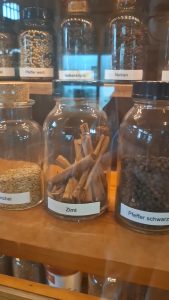
Sealed containers of spice samples at the Deutsches Hafenmuseum in Hamburg.
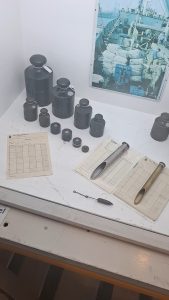
Some of the equipment that was used to take samples of imports on display at the Deutsches Hafenmuseum in Hamburg.
Whether you prefer to drink a cup of cinnamon tea to soothe an upset stomach or savour a freshly baked Franzbrötchen in Hamburg, cinnamon continues to be a spice that connects people across the globe.
If you want to learn more about Hamburg’s love of Franzbrötchen watch the video below.