Paula Muñoz and Merlin Denis–Vincendeau.
Long before becoming one of the most touristic places in Poland, Rynek Główny was already the economic and social heart of Kraków. Officially established in 1257 after the city adopted the Magdeburg urban model, the square quickly developed into one of the most important commercial centers in Central Europe. According to historian Natalia Bursiewicz, interviewed during our research in Kraków, Rynek Główny became “the central point of commerce, travel, and public life.” Streets, religious buildings, administrative institutions, and market infrastructures were all organized around the square, transforming it into the heart of medieval urban life.
Archaeological excavations conducted beneath the square reveal that the area was already active before the official creation of Rynek Główny. Researchers discovered wooden constructions, medieval transport routes, cemeteries, and residential structures dating back to the 11th century. Excavations carried out between St. Mary’s Basilica and the Cloth Hall uncovered layers of medieval roads crossing the square in several directions. These discoveries demonstrate that Rynek Główny was built on top of an already dynamic urban environment connected to communication and trade.
Although Kraków was never officially part of the Hanseatic League, the city occupied an important strategic position between Eastern and Western Europe. According to Natalia Bursiewicz, Kraków functioned as “a link between East and West.” Merchants traveling between Poland, Hungary, Germany, Flanders, and Eastern Europe regularly crossed the city. Several important trade routes connected Kraków to major European commercial regions, including the Via Magnalinking Kraków with Poznań and routes leading toward Hungary, the Baltic Sea, and the Black Sea. The Vistula River also transformed Kraków into an important river port connected to northern Europe.
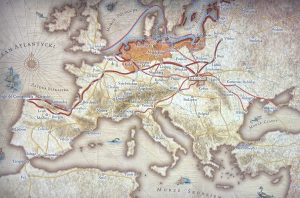 Map of the goods transportation routes connecting Kraków with other European cities. By Paula Muñoz.
Trade routes were carefully controlled by the city authorities. A medieval system known as przymus drożny, or “road compulsion,” forced foreign merchants to travel through Kraków rather than bypassing the city. Merchants who ignored these official routes risked losing their goods and freedom. This system strengthened Kraków’s commercial importance and guaranteed economic activity inside Rynek Główny. Historical records show that merchants from Kraków reached ports in Flanders through maritime routes connected to Hanseatic trade networks. In Hanseatic documents, Kraków was even referred to as “Kupferhaus”, meaning “House of Copper,” because of its importance in the copper trade.
During the 14th and 15th centuries, Hungarian copper became one of the most valuable products traded in Kraków. In 1306, King Władysław Łokietek granted the city the right to store and redistribute copper, creating an important monopoly over this trade. Copper arriving from Hungary was transported north toward Baltic ports connected to Hanseatic merchants. Lead from the mines of Olkusz, Sławków, and Trzebinia also became a major export product. Archaeologists even discovered a massive lead block weighing nearly 700 kilograms near the Great Scales of the market square.
Other goods circulated through Rynek Główny as well: salt from the Wieliczka mines, Flemish textiles, silk, spices, wax, leather products, and luxury goods arriving from Eastern Europe and the Black Sea region. According to Natalia Bursiewicz, these exchanges transformed Kraków into “an international crossroads where commerce and culture constantly mixed together.” Trade influenced not only the economy of the city, but also its cultural identity. Merchants traveling through Kraków introduced new traditions, architectural influences, artistic styles, and technologies from different parts of Europe.
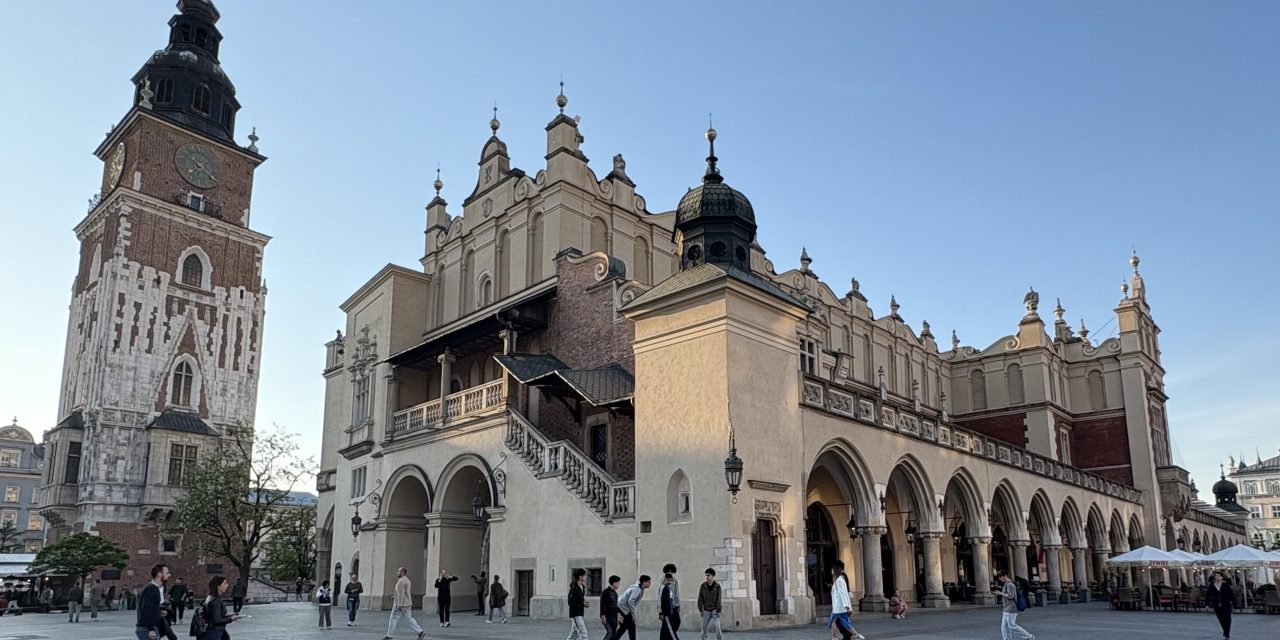
At the center of this commercial system stood the Cloth Hall, or Sukiennice, one of the most recognizable buildings in Kraków today. During the medieval period, the Cloth Hall functioned as the main commercial structure of the square. Merchants gathered there to exchange goods under organized conditions supervised by the city authorities. Around the Cloth Hall stood important infrastructures such as the Great Scales, the Small Scales, and the Rich Stalls, where goods were weighed, taxed, and distributed.
Archaeological excavations conducted between 2005 and 2008 uncovered medieval cobblestone roads, transport routes, wooden market structures, and commercial installations beneath the modern square. These discoveries show how carefully organized trade already was during the Middle Ages. Roads crossing the market were reinforced with limestone paving and wooden beams to support the movement of wagons and merchants. Goods were transported using horses, oxen, carts, and river barges. During winter, sleighs replaced wagons on frozen roads. Merchants generally traveled only thirty kilometers per day because of poor road conditions and difficult weather.
However, Rynek Główny was not only an economic center. According to Natalia Bursiewicz, the square also functioned as “a social and symbolic center” where festivals, ceremonies, royal events, and everyday interactions took place. Merchants, nobles, craftsmen, travelers, and local residents all shared the same public space. Rynek Główny therefore became much more than a market: it represented the political, economic, and cultural identity of medieval Kraków.
Today, much of this medieval history still survives underground. The archaeological museum beneath Rynek Główny preserves roads, buildings, market stalls, and objects used centuries ago by merchants and residents. These remains continue to demonstrate how Kraków developed into one of the major urban and commercial centers of medieval Europe and how Rynek Główny became a true crossroads between East and West.
While the merchants of the past have disappeared, the square remains full of life and activity. From morning until night, the square stays alive with cafés full of people, street musicians, horse-drawn carriages and visitors from around the world. Despite this modern energy, one tradition has remained unchanged for centuries, as every hour the “hejnał”, a trumpet call, is played from St. Mary’s Basilica, connecting the square to its medieval past.
 Rynek Główny square with terrace. By Merlin Denis–Vincendeau.
Walking through Rynek Główny today feels like entering a place where history and tourism mix. Tourists take photos under the Cloth Hall, street performers attract crowds, and café terraces stay busy throughout the day, creating a constantly changing atmosphere.
One of the main attractions is the Underground Museum, located beneath the square, where visitors explore archaeological remains and multimedia exhibitions about medieval Kraków. Inside the Cloth Hall, tourists move between souvenir stalls, traditional crafts and the Gallery of 19th-Century Polish Art.
Around the square, landmarks such as the Town Hall Tower, the Adam Mickiewicz Monument and the Church of St. Adalbert continue to define the area. At the same time, modern tourism has transformed the space into a place of social life and entertainment. As a result, the square is no longer only a historical site, but a dynamic space of constant movement and urban life.
The square brings together very different people throughout the day, from visitors exploring the city to those who work in its busiest corners. Although they share the same space, their experiences of how the square has changed are not always the same. To better understand this transformation, we spoke with local workers who see its daily reality from the inside.
The square brings together very different people throughout the day, from visitors exploring the city to those who work in its busiest corners. Although they share the same space, their experiences of how the square has changed are not always the same. To better understand this transformation, we spoke with local workers who see its daily reality from the inside.
Caroline Kaczmarek, who sells ceramic goods in the square, described a clear increase in tourism in recent years. ‘There are now many more people than just a few years ago’, she said. She also pointed out that improvements such as new trees and more public events have made the square more attractive. However, she added that ‘most of my customers are now tourists rather than local residents’, highlighting how the profile of visitors has changed over time.
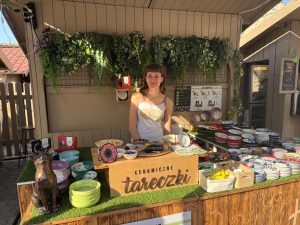 Caroline Kaczmarek sells ceramic goods. By Merlin Merlin Denis–Vincendeau.
Similarly, Ania Dragan-Górski, who sells traditional smoked cheese, emphasized the importance of tourism for the city. ‘Thousands of jobs in Kraków depend directly on visitors’, she explained, showing how tourism has become a key part of the local economy. At the same time, she noted that the square still keeps part of its cultural identity: ‘Traditional foods like pierogi and oscypek are still very present here’, demonstrating how local heritage continues within a highly international environment.
After this, the art historian Natalia Bursiewicz from the University of Kraków offered a more critical interpretation. She explained that Rynek Główny has always been the city’s main public space, used for trade, communication and social life. At the same time, she pointed out that it has changed in recent years, as restaurants, shops and services are now mainly designed for tourists.
According to Bursiewicz, this transformation has led to rising prices and a reduced presence of local residents in the square. She explains that many people from Kraków now prefer quieter districts with less tourism, while Rynek Główny has become more associated with visitors, parties, and large public events. “Local residents often only cross the square when they need to,” she notes, suggesting that the space is gradually shifting from a local meeting point to a tourist-oriented destination.
She also highlighted the growing number of Airbnb apartments and the lack of permanent residents in the area, a process she believes is affecting many historic European cities. In her view, the problem is not the lack of workers in the square, since tourism continues to generate employment, but the decreasing number of people actually living there. “There will always be people working here,” she explained, “but fewer people creating a real neighbourhood life.”
In contrast, a tourist visiting the square offered a more positive perspective. Laura Murado said she came to Kraków following recommendations from friends and due to her interest in history and gastronomy. She said the square “surprised me a lot” and added that it is “much bigger than I expected,” emphasizing its scale.
The tourist also emphasized the variety of experiences in the square, from food stalls to historical architecture. She said it ‘still feels authentic, even though there are a lot of people visiting’ and added that the Cloth Hall ‘kind of makes you travel through history and doesn’t feel artificial at all,’ reinforcing a favorable view of the experience.
In conclusion, despite its crowds and constant transformation, Rynek Główny remains the beating heart of Kraków. Its medieval structure has been preserved, but its role has clearly evolved into a much more complex urban space. Today, it is a place where history, tourism, culture and everyday city life overlap and interact continuously. Even so, it continues to work as a central meeting point in the city, where different people and stories come together in the same space.