12 juni 2026 – Boedapest
Door Isabella van de Luijtgaarden en Noor Prummel
De Roma vormen de grootste etnische minderheid van Hongarije, maar tegelijkertijd ook een van de meest gemarginaliseerde groepen van het land. Al eeuwenlang kampen zij met uitsluiting, discriminatie en hardnekkige vooroordelen. Ondanks pogingen tot integratie blijven veel Roma in sociaal en economisch kwetsbare posities terechtkomen, terwijl negatieve stereotypen hun beeldvorming in de samenleving blijven bepalen.
Tegelijkertijd klinkt vanuit de gemeenschap zelf een groeiende roep om verandering. Niet alleen door betere kansen op onderwijs en werk, maar ook door meer zichtbaarheid en vertegenwoordiging in de media. In Boedapest proberen journalisten, programmamakers en juristen daar ieder op hun eigen manier aan bij te dragen. Terwijl Hongarije na een politieke machtswisseling een nieuwe koers probeert te varen, rijst de vraag of ook de positie van de Roma daadwerkelijk kan veranderen.
Aan de buitenkant lijkt het allesbehalve een mediagebouw. Beneden zit een kapper en een sportschool en vervolgens moet men door een security om binnen te komen. Net over de rivier aan de Boeda-zijde van de stad Boedapest staat een 15 verdiepingen hoog gebouw met hier en daar een satellietschotel.
Het gammele liftje stijgt naar de 6e verdieping. Boven opent de deur naar een grauwe, lange, nauwe gang met een bordje ‘Dikh TV’ en daarnaast ‘Radio Dikh’. Links van de lift zit een kamer met een grote ronde tafel met vier verschillende bureaustoelen eraan. “Dit is een soort algemene redactieruimte,” vertelt redacteur Lajos Puporka. Hij biedt een kop koffie aan. “Met room?” vraagt hij, waarna hij met een bus slagroom uit het keukentje loopt.
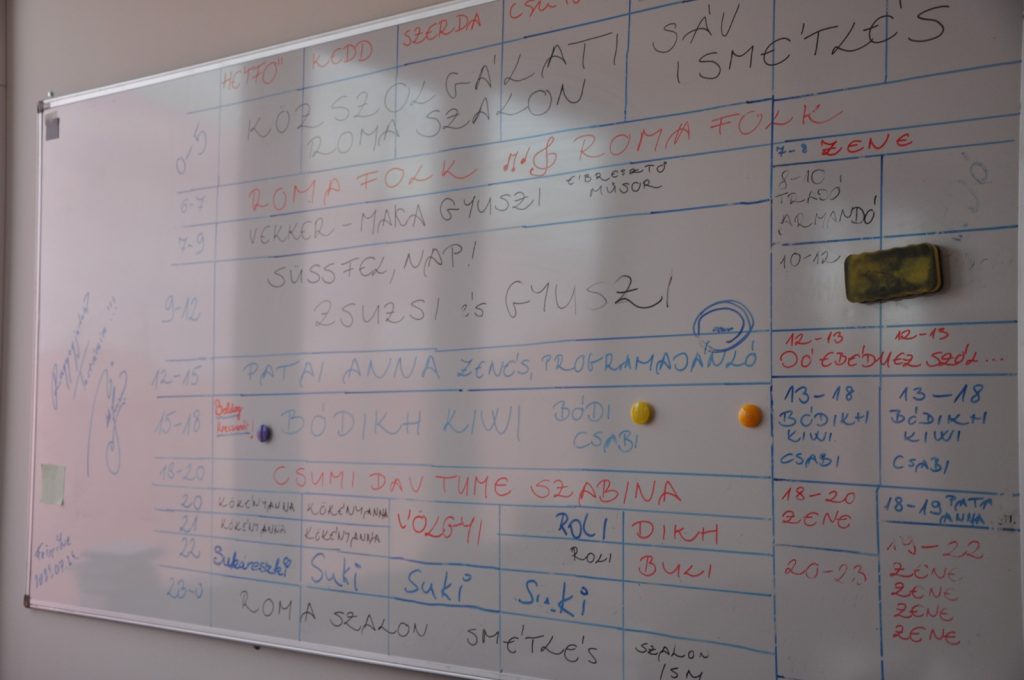
De met IKEA-meubels gevulde ruimte was niet heel sfeervol. Het enige wat de aandacht trok, was het programma van de dag dat in gekleurde letters groots op het whiteboard stond geschreven. ‘Roma-volksmuziek 06:00 uur-07:00 uur’ trok meteen de aandacht. Iedereen neemt ondertussen plaats. Naast Lajos, een kleine, getinte man met een wankel brilletje, schuift ook Andras Fai, algemeen directeur, aan.
Dikh TV is de eerste Hongaarse commerciële 24-uurszender met een Roma-thema. Wat in 2012 begon als een YouTube-kanaal met muziekvideo’s, is sinds maart 2019 uitgegroeid tot een landelijke zender. Het doel van het platform is om de heersende negatieve stereotypen, zoals arm, asociaal of crimineel, rondom de Roma-gemeenschap in de media te doorbreken. Zij hebben de missie dit beeld te vervangen door realistische, positieve en authentieke representaties.
Zo trots als een vader vertelt András over het platform. Lajos knikt af en toe instemmend. Het is erg stil in de ruimte en tijdens het gesprek klinkt er een kleine echo. “Het gaat dan wellicht over Roma, maar uiteindelijk is het voor iedereen,” benadrukt András.
“Het gaat dan wellicht over Roma, maar uiteindelijk is het voor iedereen.”
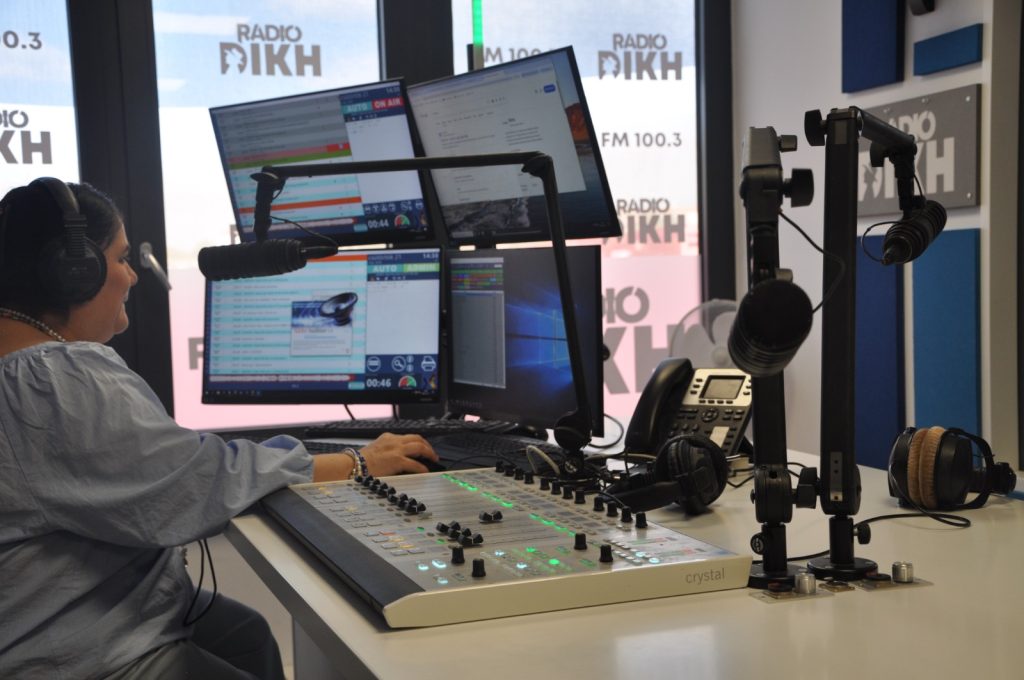
Ondertussen loopt er een kleurrijk geklede vrouw de ruimte binnen. Ze groet iedereen opgewekt en opent een deur. Er verschijnt een kleine regiekamer met daarachter een radiostudio. Ze rommelt wat rond, maar neemt al vrij snel plaats in de studio. “Zij zal de komende uren op de radio te horen zijn,” vertelt Lajos.
Sinds 2022 is het platform uitgebreid met Radio Dikh. De radio zendt voornamelijk Roma-programma’s uit. Er wordt voornamelijk Roma-muziek gedraaid, aangevuld met kennis van de artiesten en daarnaast maakt taal- en dansonderwijs ook deel uit van hun programma. Op de agenda staat ook vaak Roma-kunst, dan worden literatuur, theater en film besproken. Elke twee uur wordt er op de radio een korte taalles gegeven om de Roma-taal te behouden.
Dikh Media heeft een bijzondere positie binnen Hongarije. Het platform is de enige omroep die zich volledig richt op de Roma-gemeenschap en haar cultuur. “Als wij er niet zouden zijn, dan zouden we niet vertegenwoordigd worden binnen de media”, zegt Lajos Puporka.
Dat streven naar zichtbaarheid komt op een bijzonder moment. Na zestien jaar onder premier Viktor Orbán kreeg Hongarije dit voorjaar een nieuwe regering onder leiding van Péter Magyar. Voor veel Hongaren betekende dat een politieke aardverschuiving. Ook binnen de Roma-gemeenschap wordt voorzichtig gekeken naar wat die machtswisseling kan betekenen.
Op de redactie van Dikh Media lopen de verwachtingen uiteen. Vivien Vida, programmamanager bij het platform, kijkt optimistisch naar de toekomst. “Ik ben blij met de regimewisseling. Het regime van Orbán was te veel. Hij was zestien jaar aan de macht en het is tijd voor verandering.”
Ze denkt dat de nieuwe regering mogelijk ook gunstig kan uitpakken voor de Roma-gemeenschap. Nog voordat ze haar gedachte heeft afgemaakt, reageert Lajos.
“Zij hoopt, want ze is jong, maar ik ben ervaren.”
Aan tafel wordt gelachen. Toch schuilt achter die opmerking meer dan een generatieverschil. Voor Lajos weerspiegelt ze eeuwen aan ervaringen van een gemeenschap die telkens opnieuw hoorde dat verandering eraan kwam.
“Maar aan de andere kant,” vult hij aan, “als je niet denkt dat het morgen beter zal zijn, is het misschien beter om jezelf op te hangen. Je moet altijd hoopvol blijven.”
De scepsis van Lajos komt niet uit het niets. De geschiedenis van de Roma in Hongarije wordt al eeuwen gekenmerkt door uitsluiting, discriminatie en mislukte integratiepogingen.
Historische context
Lajos staat op en stelt voor een kleine rondleiding te geven over de redactie. Hij loopt voorop en straalt wanneer hij uitleg geeft bij elke deur van de verdieping.
Dat Dikh Media de enige omroep is die zich volledig focust op de Roma-gemeenschap, heeft onder andere te maken met het negatieve beeld binnen de Hongaarse samenleving over de gemeenschap. Zij worden al jarenlang structureel sociaal uitgesloten en zelfs gediscrimineerd. “Het probleem is dat je zo makkelijk ziet dat wij Roma zijn en anderen niet,” vertelt Lajos.
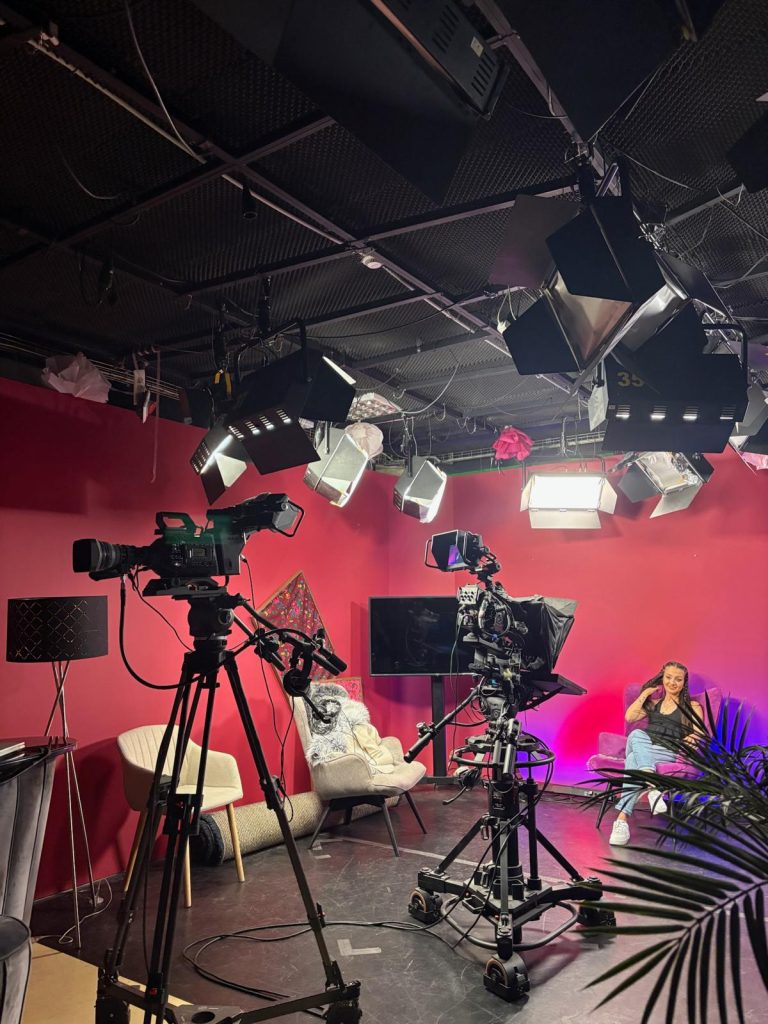
Hij loopt nog steeds voorop richting de tv-studio. Dat hij deel uitmaakt van de Roma-gemeenschap, betekent niet dat hij dagelijks wordt geconfronteerd met vragen over het leven als een Roma. Hij wacht eerst af, maar komt daarna wat losser om ook meer over zijn persoonlijk verhaal te delen.
De beeldvorming rondom de Roma gaat ver terug in de tijd, tot de 15e eeuw, toen de gemeenschap zich in Hongarije vestigde. Hun wortels reiken terug tot in India. De exacte reden waarom zij vanuit daar toentertijd naar het westen trokken, is niet helemaal helder en blijft een punt van discussie. De één zegt dat ze moesten vluchten voor Turkse troepen, terwijl anderen beweren dat ze deze juist volgden naar het Karpatenbekken, een laaglandgebied in Centraal- en Zuidoost-Europa, dat ook wel bekendstaat als het Pannonische Bekken.
Volgens Lajos was het voor de Roma nagenoeg onmogelijk om in de samenleving te integreren. Hun gedwongen integratie begon met Maria Theresia, de toenmalige keizerin van de Habsburgse monarchie. Vanaf het begin wordt de Roma-gemeenschap geconfronteerd met discriminatie, iets wat diepgeworteld raakte in de samenleving. Zo voerde de Habsburgse monarchie destijds al campagne voor de vestiging en assimilatie van de Roma, wat samenging met extreme uitsluiting. “Zij dwong de Roma zich te vestigen. Door haar handelen raakte de gemeenschap verdeeld, omdat het verboden was om de Roma-taal te spreken,” vertelt Lajos.
Hij zit er kalm bij en vertelt dit verhaal alsof het een voor-het-slapen-gaan-verhaal is. Ondertussen pakt hij een nieuw glaasje water dat hij vervolgens in zijn handen voor zich blijft houden.
In de periode van 1920 tot de Tweede Wereldoorlog werden Roma beschuldigd van het veroorzaken van epidemieën en kregen ze te maken met discriminerende wetten. Tijdens de Tweede Wereldoorlog nam de uitsluiting alleen maar toe, wat uiteindelijk zelfs leidde tot genocide. Er wordt geschat dat tussen de 5.000 en 30.000 Roma zijn vermoord door de nazi’s.
In 1961 werd de ‘Roma-kwestie’ gezien als een sociaal (economisch) probleem in plaats van een etnische kwestie. Volgens Lajos was dit het eerste concrete besluit van de communistische partij om de Roma-bevolking te integreren. Destijds woonden veel Roma in de bossen en op het platteland. Zij werden vervolgens naar de rand van dorpen en steden gebracht, waar huizen voor hen werden gebouwd. Pas in 1993 zorgde een progressieve wet ervoor dat de Roma officieel werden erkend als etnische minderheid.
In de jaren 90 kwamen Roma in de media vooral negatief in beeld. Ze werden vaak geschetst als arm en crimineel. Om dit beeld te veranderen, werden in de vroege jaren van 2000 vaker Roma-personages geïntroduceerd in televisieseries of realityshows. Dit pakte echter averechts uit. In plaats van een verbetering van het beeld bleven de negatieve stereotypen bestaan, wat vooroordelen bij het publiek in stand hield.
Het absolute kantelpunt volgde in 2006, na een fatale mishandeling van een leraar door een groep Roma. De leraar, die met zijn twee kinderen in de auto reed, raakte bijna een Roma-meisje. Hoewel zij niet gewond raakte, trokken Roma-buurtbewoners de man uit zijn auto. Ze sloegen hem in elkaar tot hij voor de ogen van zijn kinderen overleed. Dit incident werd opgepakt door de media en politiek, met als gevolg dat de discriminatie van de Roma-gemeenschap sindsdien enorm is toegenomen.
“Het is een probleem dat van beide kanten komt, zowel vanuit de Roma-gemeenschap als de rest van de samenleving,” legt jurist Brunó Faragó uit. Brunó zet zich al langere tijd in voor de Roma-gemeenschap door onder andere erg aanwezig te zijn in de media en zich daar uit te spreken over de gemeenschap. Ook moedigde hij mensen aan om te gaan stemmen voor verandering tijdens de afgelopen verkiezingen. Hij voegt daaraan toe: “Er is de afgelopen dertig jaar een bepaald beeld gecreëerd dat nog altijd standhoudt, dat komt doordat mensen zich niet uitspreken; ze zwijgen.”
“Die situatie bestaat nog steeds, omdat hun huizen getto’s zijn geworden en dat is in het kort het verhaal van de Roma en waarom ze niet geïntegreerd zijn.”
Lajos zet zijn glas water, dat ondertussen leeg is, terug op tafel en slaakt een zucht. “Dat is in het kort het verhaal van de Roma en waarom we niet geïntegreerd zijn.” Tegenwoordig wonen de meeste Roma, zoals Lajos het zelf beschrijft, in de getto’s. “Als je in de getto woont, heb je niets anders dan een klein huisje. In Oost-Europa bestaat deze situatie overal en al heel lang. Afgescheiden van de rest van de bevolking.” Aangezien veel Roma hier ook niet de (financiële) middelen hebben om door te groeien in de samenleving, blijft dit vaak generatie op generatie in stand.
Ondanks de unieke propositie die Dikh Media heeft binnen Hongarije, denken ze niet dat ze het negatieve perspectief van de samenleving op de Roma-gemeenschap kunnen veranderen. “De media spelen natuurlijk een rol, dat is normaal, maar ze kunnen je kijk op de wereld niet veranderen”, aldus Lajos.
Enige ‘zichtbare’ minderheidsgroep
Er is een duidelijk verschil zichtbaar tussen de etnische minderheidsgroepen in Nederland en Hongarije. De Nederlandse samenleving is pluriformer van aard. Er wonen veel verschillende grote etnische groepen, zoals mensen met een Marokkaanse, Turkse, Surinaamse, Afrikaanse of Aziatische achtergrond. Hierdoor is het in Nederland heel normaal om op straat iemand tegen te komen die er uiterlijk anders uitziet dan zichzelf.
In Hongarije ligt dit anders. Volgens de Hongaarse volkstelling van 2022 identificeerden ruim 210.000 personen zich als Roma (2,2% van de bevolking). Onderzoekers wijzen er echter op dat deze cijfers waarschijnlijk een onderschatting vormen, omdat etnische afkomst via vrijwillige zelfidentificatie wordt geregistreerd. Internationale organisaties zoals de Raad van Europa schatten het aantal Roma in Hongarije op ongeveer 700.000 personen (ongeveer 7% van de bevolking), terwijl recente Hongaarse demografische studies uitkomen op ongeveer 600.000 tot 775.000 personen.
Hoewel ook Duitsers, Slowaken en Roemenen grote minderheidsgroepen in het land vormen, is er een belangrijk verschil. De Roma-gemeenschap is de enige grote minderheid die zich door specifieke fysieke kenmerken uiterlijk onderscheidt van de meerderheid. Doordat zij de enige ‘zichtbare’ minderheid zijn, vallen zij binnen de Hongaarse samenleving veel meer op.
Discriminatie onder de Roma
Vandaag de dag wordt de Roma-gemeenschap nog steeds gediscrimineerd, wat regelmatig leidt tot agressie en uitsluiting. Lajos ervoer dit zelf. Hij aarzelt even om het te delen, maar geeft uiteindelijk toe. “Ze zagen aan mijn uiterlijk dat ik Roma ben, en toen vielen ze me aan in de tram. Maar ja, zo gaat dat nu eenmaal. Het hoort er nu eenmaal bij.” Volgens hem is dit ‘normaal’ geworden wanneer je een Roma-achtergrond hebt.
Tijdens dit gesprek komt Vivien Vida, programmamanager bij Dikh Media, binnenlopen. Een jonge vrouw met lang zwart haar, een hippe outfit en een bril. Lajos wijst naar haar en begint: “Zij is half Roma.”
“Klopt,” vervolgt ze terwijl ze plaatsneemt. Ze is duidelijk niet verbaasd over het onderwerp. “Mijn moeder is Roma en mijn vader Hongaars. Mensen zien qua uiterlijk niet dat ik Roma ben en dus word ik er ook niet voor herkend,” legt Vivien uit. “Haar uiterlijk lijkt veel meer op dat van een Europeaan”, voegt Lajos eraan toe.
Ook Brunó heeft ervaringen op het gebied van discriminatie: “Ze lieten me bijvoorbeeld niet binnen in een club, omdat ze zagen dat ik een donkere huidskleur heb.”
Volgens Brunó is dit voornamelijk om veiligheidsredenen. In het verleden zijn er veel incidenten geweest tussen Roma en niet-Roma. Er zijn verschillende Roma-groepen, en die verschillen zo sterk dat ze zich ook anders gedragen. Daarbij zijn er voorbeelden van mensen die iemand hebben mishandeld. Op basis van deze verhalen kiest veel beveiliging ervoor om uit voorzorg niemand binnen te laten. “Natuurlijk is dit vanuit juridisch oogpunt niet oké, maar als ik het bekijk vanuit het perspectief van de andere kant, proberen zij het te verdedigen vanuit een veiligheidsoogpunt.”
Om dit te veranderen, biedt het advocatenbureau waar Brunó werkt gratis juridische bijstand aan in antidiscriminatiezaken. Daarbij denkt hij dat als er een forum of servicepunt hiervoor komt, dat men wel twee keer moet nadenken voordat ze de toegang tot een club weigeren of iemand een appartement weigeren vanwege hun huidskleur. “We moeten dit soort mechanismen echt gaan opzetten”, aldus Brunó.
Maar de echte verandering begint volgens Brunó bij de Roma-gemeenschap zelf: “We moeten onszelf versterken, niet per se politiek, maar de sociale positie van de Roma in Hongarije.”
Ontstaan sociaal probleem
De kern van de problematiek rondom de Roma-gemeenschap ligt niet in culturele verschillen, maar het gaat om een sociaal vraagstuk. Lajos trekt hierbij een historische vergelijking met de Joodse gemeenschap. Zowel de Joden als de Roma kwamen naar Hongarije als nomaden, beide groepen hadden geen recht op land. Het integratieprobleem dat hieruit ontstond, is echter geen cultureel probleem. Het is niet de cultuur die voor scheiding zorgt. Als je dieper in de Hongaarse cultuur kijkt, zie je dat de Roma-cultuur hierin verweven is. Hongaarse muziek en tradities werden driehonderd jaar geleden al door de Roma gepraktiseerd. “We kunnen dan niet zeggen dat het een cultureel probleem is, het is een sociaal probleem, een integratieprobleem, een segregatieprobleem, een gettoprobleem.”
De grote vraag in Europa en Hongarije is nu wat ze moeten doen met deze groepen die buiten de samenleving vallen. Ze hebben vaak geen formele, nationaal erkende opleiding en doen vaak werk van lage kwaliteit tegen een laag loon, waardoor ze arm zijn. Als er binnen de Roma-bevolking meer mensen zijn met een middelbare school- of universitaire opleiding, verloopt de integratie in de samenleving een stuk gemakkelijker. Maar in Hongarije hebben ze dit nooit gestimuleerd. “Ik vraag me af of ze dit ook zullen doen.” Volgens Lajos is scholing een van de oplossingen, want je kunt een gesegregeerde bevolking niet zomaar integreren.
“Zij hoopt”
Dat er dus een sociaal probleem speelt, is duidelijk, maar gaat dit veranderen nu de nieuwe regering aan de macht is gekomen? Op zondag 12 april trokken alle straten vol in Boedapest en op meer plekken in Hongarije, want de oppositiepartij onder leiding van Péter Magyar won deze avond de verkiezingen.
“Sommige mensen zijn tevreden met deze nieuwe regering, andere mensen zijn er niet blij mee”, concludeert Lajos op de vraag wat hij van de verkiezingsuitslag vindt. Vivien kijkt een stuk optimistischer naar de winst van Magyar. “Ik ben blij met de regimewisseling. Het regime van Orbán was te veel. Hij was 16 jaar aan de macht en het is tijd voor een verandering.” Daarbij denkt ze dat het misschien beter is voor de Roma-gemeenschap.
Lajos kijkt haar aan en zegt: “Zij hoopt, want ze is nog jong, maar ik ben meer ervaren. Maar aan de andere kant, als je niet denkt dat het morgen beter zal zijn, is het misschien beter om jezelf op te hangen. Je moet altijd hoopvol blijven.”
Voorafgaand aan de verkiezingen probeerde Brunó mensen aan te moedigen om te gaan stemmen en het belang daarvan te benadrukken. “Vanuit het perspectief van de Roma was het natuurlijk vreselijk, maar eigenlijk vanuit vrijwel elk perspectief.” Hij beargumenteert dit door te wijzen naar de vele sociale problemen die er op dit moment spelen in Hongarije. Volgens hem concentreert het grootste deel van deze problematiek zich binnen de Roma-gemeenschap zelf, of heeft het invloed op een deel van de gemeenschap. Tegelijkertijd benadrukt hij dat de gevolgen hiervan breder zijn; ook een deel van de samenleving wordt getroffen, niet alleen Roma.
De rode lijn
Dat veel Roma positief kijken naar de nieuwe regering is niet heel gek, want de oude regering maakte bepaalde uitspraken die niet altijd even gepast waren. Een voorbeeld van een aantal maanden terug, waarin de voormalige minister van Transport, János Lázár, zei: “Als we geen migranten willen, en iemand de toiletten in onze intercitytreinen moet schoonmaken, omdat de Hongaarse kiezers niet erg bereid zijn om andermans smerige toiletten schoon te maken, dan moeten we onze binnenlandse reserves aanspreken en onze binnenlandse reserves zijn de Hongaarse zigeuners.”
Voor Brunó was dit de rode lijn waarop hij besloot niet langer stil te blijven. “Laten we het zo zeggen: er zijn fundamentele wetten, zoals de wet om mens te zijn, dat is wat ons onderscheidt van dieren. Als je deze wet schendt, dan wordt er voor mij een grens overschreden”, legt Brunó uit. Hij vond dat het te ver ging en besloot daarom zijn stem te laten horen. Inmiddels trekken zijn video’s veel views en krijgt hij veel positieve reacties.
Om die reden bouwt hij nu samen met andere Roma-advocaten aan een initiatief met een heel ander perspectief. “Ik spreek niet meer op de traditionele manier over de Roma-kwestie of het Roma-probleem”, zegt Brunó. Volgens hem hoeven we geen medelijden te hebben met arme Roma die niet genoeg hulp krijgen. In plaats daarvan moet er een nieuw perspectief komen, bekeken vanuit hooggekwalificeerde professionals. Het verhaal moet niet langer gaan over: ‘Ik was arm en het was heel moeilijk om naar school en de universiteit te gaan.’ De focus moet juist op het heden en de toekomst worden gelegd.
Hoe de toekomst van de Roma-gemeenschap eruitziet, weet niemand zeker. Lajos haalt zijn schouders op wanneer die vraag wordt gesteld. “Ik ben geen god, ik kan niets zeggen over de toekomst.”
Toch ziet Brunó Faragó een verantwoordelijkheid voor een nieuwe generatie Roma-professionals. Volgens hem moet het gesprek veranderen. Niet langer alleen over armoede, achterstand en problemen, maar ook over mensen die inmiddels arts, advocaat, ondernemer of journalist zijn geworden. “Wij moeten rond de tafel gaan zitten en het proces starten”, zegt hij. “We kunnen niet toestaan dat anderen ons verhaal blijven vertellen.”
Even daarvoor zaten Lajos en Vivien nog tegenover elkaar aan tafel. Zij sprak hoopvol over de nieuwe regering, hij reageerde voorzichtig. De één kijkt vooruit, de ander kijkt terug op wat al geprobeerd is. Maar ondanks hun verschillen kwamen ze uiteindelijk tot dezelfde conclusie: zonder hoop is verandering onmogelijk.
Buiten stroomt de Donau onverstoorbaar door Boedapest. In de radiostudio klinkt ondertussen Roma-muziek door de speakers. Hier, op de zesde verdieping van een anoniem kantoorgebouw, blijven ze werken aan een ander verhaal. Niet omdat ze zeker weten dat het iets verandert, maar omdat niets veranderen geen optie is.
Dataverantwoording cijfers Hongarije: De percentages zijn berekend op basis van de Hongaarse volkstelling van 2022 van de Hongaarse Centrale Dienst voor de Statistiek (KSH). Dit is de meest recente officiële bron over de etnische samenstelling van de Hongaarse bevolking en daarmee de meest betrouwbare dataset die momenteel beschikbaar is. Tegelijkertijd moet worden opgemerkt dat etniciteit in de volkstelling op basis van vrijwillige zelfidentificatie werd geregistreerd, waardoor sommige minderheidsgroepen mogelijk niet volledig in de cijfers zijn vertegenwoordigd.
Dataverantwoording cijfers Nederland: De cijfers over de Nederlandse bevolking zijn afkomstig van het Centraal Bureau voor de Statistiek (CBS), het nationale statistiekbureau van Nederland. De gegevens beschrijven de bevolkingssamenstelling op 1 januari 2025 en zijn gebaseerd op de Basisregistratie Personen (BRP), waarin alle inwoners van Nederland zijn geregistreerd. Hierdoor vormen deze cijfers de meest actuele en complete officiële bron voor onderzoek naar herkomst en migratie in Nederland.
Translated version:
“She hopes, because she is young, but I am experienced”
12 June – Budapest
Isabella van de Luijtgaarden & Noor Prummel
The Roma are the largest ethnic minority in Hungary, but at the same time one of the most marginalised groups in the country. For centuries, they have faced exclusion, discrimination and persistent prejudice. Despite attempts at integration, many Roma continue to end up in socially and economically vulnerable positions, while negative stereotypes continue to shape how they are viewed in society.
At the same time, a growing call for change is coming from within the community itself. Not only through better opportunities in education and work, but also through more visibility and representation in the media. In Budapest, journalists, programme makers and lawyers are each trying to contribute to that in their own way. As Hungary tries to take a new course after a political change of power, the question arises whether the position of the Roma can truly change as well.
From the outside, it looks anything but a media building. Downstairs there is a hairdresser and a gym, and then you have to pass through security to get inside. Just across the river on the Buda side of Budapest stands a 15-storey building with a satellite dish here and there.
The rickety little lift rises to the 6th floor. Upstairs, the door opens onto a grey, long, narrow hallway with a sign saying ‘Dikh TV’ and next to it ‘Radio Dikh’. To the left of the lift is a room with a large round table and four different office chairs around it. “This is a kind of general newsroom,” says editor Lajos Puporka. He offers a cup of coffee. “With cream?” he asks, after which he walks out of the small kitchen with a can of whipped cream.
The room, filled with IKEA furniture, was not very atmospheric. The only thing that caught the eye was the day’s schedule, written in large colourful letters on the whiteboard. ‘Roma folk music 06:00-07:00’ immediately drew attention. Meanwhile, everyone takes a seat. Alongside Lajos, a small, dark-skinned man with wobbly glasses, Andras Fai, general director, also joins the table.
Dikh TV is the first Hungarian commercial 24-hour channel with a Roma theme. What began in 2012 as a YouTube channel with music videos has, since March 2019, grown into a national channel. The aim of the platform is to break through the prevailing negative stereotypes surrounding the Roma community in the media, such as poor, antisocial or criminal. Their mission is to replace this image with realistic, positive and authentic representations.
Like a proud father, András talks about the platform. Lajos nods in agreement from time to time. It is very quiet in the room and during the conversation there is a slight echo. “It may be about Roma, but in the end it is for everyone,” András emphasises.
“It may be about Roma, but in the end it is for everyone.”
Meanwhile, a colourfully dressed woman walks into the room. She greets everyone cheerfully and opens a door. A small control room appears, with a radio studio behind it. She rummages around for a bit, but soon takes a seat in the studio. “She will be on the radio for the next few hours,” Lajos says.
Since 2022, the platform has expanded with Radio Dikh. The radio station mainly broadcasts Roma programmes. It mostly plays Roma music, supplemented with knowledge about the artists, and language and dance education are also part of their programming. Roma art is also often on the agenda, with literature, theatre and film being discussed. Every two hours, the radio gives a short language lesson to preserve the Roma language.
Dikh Media holds a special position within Hungary. The platform is the only broadcaster that focuses entirely on the Roma community and its culture. “If we were not here, we would not be represented in the media,” says Lajos Puporka.
That pursuit of visibility comes at a special moment. After sixteen years under Prime Minister Viktor Orbán, Hungary received a new government this spring led by Péter Magyar. For many Hungarians, that meant a political earthquake. Within the Roma community too, people are cautiously looking at what that change of power might mean.
At the Dikh Media newsroom, expectations differ. Vivien Vida, programme manager at the platform, looks optimistically towards the future. “I am happy with the regime change. Orbán’s regime was too much. He was in power for sixteen years and it is time for change.”
She thinks the new government could possibly also turn out well for the Roma community. Before she has even finished her thought, Lajos responds.
“She hopes, because she is young, but I am experienced.”
People at the table laugh. Yet behind that comment lies more than just a generational difference. For Lajos, it reflects centuries of experiences from a community that was repeatedly told that change was coming.
“But on the other hand,” he adds, “if you don’t think tomorrow will be better, maybe it is better to hang yourself. You always have to remain hopeful.”
Lajos’s scepticism does not come out of nowhere. The history of the Roma in Hungary has been marked for centuries by exclusion, discrimination and failed attempts at integration.
Historical context
Lajos stands up and suggests giving a small tour of the newsroom. He walks ahead and beams as he explains every door on the floor.
The fact that Dikh Media is the only broadcaster that focuses entirely on the Roma community has, among other things, to do with the negative image of the community within Hungarian society. For years, they have been structurally socially excluded and even discriminated against. “The problem is that you can so easily see that we are Roma and others are not,” Lajos says.
He is still walking ahead towards the TV studio. The fact that he is part of the Roma community does not mean that he is confronted daily with questions about life as a Roma. At first he waits, but then he loosens up a little and starts sharing more about his personal story as well.
The image surrounding the Roma goes far back in time, to the 15th century, when the community settled in Hungary. Their roots go back to India. The exact reason why they moved west from there at the time is not entirely clear and remains a point of debate. Some say they had to flee from Turkish troops, while others claim they actually followed them to the Carpathian Basin, a lowland area in Central and Southeastern Europe, also known as the Pannonian Basin.
According to Lajos, it was almost impossible for the Roma to integrate into society. Their forced integration began with Maria Theresa, the then empress of the Habsburg Monarchy. From the beginning, the Roma community was confronted with discrimination, something that became deeply rooted in society. The Habsburg Monarchy, for example, already campaigned at the time for the settlement and assimilation of the Roma, which went hand in hand with extreme exclusion. “She forced the Roma to settle. Because of her actions, the community became divided, because it was forbidden to speak the Roma language,” Lajos says.
He sits calmly and tells this story as if it is a bedtime story. Meanwhile, he takes a new glass of water, which he then keeps holding in his hands in front of him.
In the period from 1920 to the Second World War, Roma were accused of causing epidemics and faced discriminatory laws. During the Second World War, exclusion only increased, eventually even leading to genocide. It is estimated that between 5,000 and 30,000 Roma were murdered by the Nazis.
In 1961, the ‘Roma question’ was seen as a social and economic problem rather than an ethnic issue. According to Lajos, this was the first concrete decision by the Communist Party to integrate the Roma population. At the time, many Roma lived in forests and in the countryside. They were then brought to the edges of villages and cities, where houses were built for them. Only in 1993 did a progressive law ensure that the Roma were officially recognised as an ethnic minority.
In the 1990s, Roma were mainly shown negatively in the media. They were often portrayed as poor and criminal. To change this image, Roma characters were more often introduced in television series or reality shows in the early 2000s. However, this backfired. Instead of improving the image, the negative stereotypes remained, keeping prejudices among the public alive.
The absolute turning point came in 2006, after the fatal assault of a teacher by a group of Roma. The teacher, who was driving with his two children in the car, almost hit a Roma girl. Although she was not injured, Roma residents from the neighbourhood pulled the man out of his car. They beat him up until he died in front of his children. This incident was picked up by the media and politics, with the result that discrimination against the Roma community has increased enormously since then.
“It is a problem that comes from both sides, both from the Roma community and the rest of society,” explains lawyer Brunó Faragó. Brunó has been committed to the Roma community for some time, among other things by being very present in the media and speaking out there about the community. He also encouraged people to vote for change during the recent elections. He adds: “A certain image has been created over the past thirty years that still remains, and that is because people do not speak out; they remain silent.”
“That situation still exists, because their houses have become ghettos and that is, in short, the story of the Roma and why they are not integrated.”
Lajos puts his glass of water, which is now empty, back on the table and sighs. “That is, in short, the story of the Roma and why we are not integrated.” Today, most Roma live, as Lajos himself describes it, in the ghettos. “If you live in the ghetto, you have nothing other than a small house. In Eastern Europe, this situation exists everywhere and has existed for a very long time. Separated from the rest of the population.” Since many Roma there also do not have the financial means to move up in society, this often continues from generation to generation.
Despite Dikh Media’s unique proposition within Hungary, they do not think they can change society’s negative perspective on the Roma community. “The media play a role, of course, that is normal, but they cannot change your view of the world,” says Lajos.
The only ‘visible’ minority group
There is a clear difference between ethnic minority groups in the Netherlands and Hungary. Dutch society is more pluralistic in nature. Many large ethnic groups live there, such as people with Moroccan, Turkish, Surinamese, African or Asian backgrounds. Because of this, in the Netherlands it is very normal to encounter someone on the street who looks different from oneself.
In Hungary, this is different. According to the Hungarian census of 2022, more than 210,000 people identified as Roma, 2.2% of the population. Researchers point out, however, that these figures are probably an underestimate, because ethnic origin is registered through voluntary self-identification. International organisations such as the Council of Europe estimate the number of Roma in Hungary at around 700,000 people, about 7% of the population, while recent Hungarian demographic studies arrive at approximately 600,000 to 775,000 people.
Although Germans, Slovaks and Romanians also form large minority groups in the country, there is an important difference. The Roma community is the only large minority that visually distinguishes itself from the majority through specific physical characteristics. Because they are the only ‘visible’ minority, they stand out much more within Hungarian society.
Discrimination against Roma
Today, the Roma community is still discriminated against, which regularly leads to aggression and exclusion. Lajos experienced this himself. He hesitates for a moment before sharing it, but eventually admits it. “They could see from my appearance that I am Roma, and then they attacked me on the tram. But yes, that is just how it goes. It is simply part of it.” According to him, this has become ‘normal’ when you have a Roma background.
During this conversation, Vivien Vida, programme manager at Dikh Media, walks in. A young woman with long black hair, a trendy outfit and glasses. Lajos points at her and begins: “She is half Roma.”
“That’s right,” she continues as she takes a seat. She is clearly not surprised by the subject. “My mother is Roma and my father is Hungarian. People cannot see from my appearance that I am Roma, so I am not recognised as such either,” Vivien explains. “Her appearance looks much more like that of a European,” Lajos adds.
Brunó also has experiences with discrimination: “For example, they did not let me into a club because they saw that I have darker skin.”
According to Brunó, this is mainly for security reasons. In the past, there have been many incidents between Roma and non-Roma. There are different Roma groups, and they differ so much that they also behave differently. There are also examples of people who have assaulted someone. Based on these stories, many security guards choose, as a precaution, not to let anyone in. “Of course this is not okay from a legal point of view, but if I look at it from the perspective of the other side, they try to defend it from a security point of view.”
To change this, the law firm where Brunó works offers free legal assistance in anti-discrimination cases. He also thinks that if there is a forum or service point for this, people will think twice before refusing someone entry to a club or refusing someone an apartment because of their skin colour. “We really have to start setting up these kinds of mechanisms,” says Brunó.
But according to Brunó, real change begins with the Roma community itself: “We have to strengthen ourselves, not necessarily politically, but the social position of the Roma in Hungary.”
The origins of a social problem
The core of the problem surrounding the Roma community does not lie in cultural differences, but in a social issue. Lajos draws a historical comparison here with the Jewish community. Both Jews and Roma came to Hungary as nomads, and both groups had no right to land. The integration problem that arose from this, however, is not a cultural problem. It is not culture that creates separation. If you look deeper into Hungarian culture, you see that Roma culture is interwoven with it. Hungarian music and traditions were already practised by the Roma three hundred years ago. “So we cannot say that it is a cultural problem, it is a social problem, an integration problem, a segregation problem, a ghetto problem.”
The big question in Europe and Hungary now is what they should do with these groups that fall outside society. They often have no formal, nationally recognised education and often do low-quality work for low wages, which makes them poor. If more people within the Roma population have a secondary school or university education, integration into society becomes much easier. But in Hungary, they have never encouraged this. “I wonder whether they will do this as well.” According to Lajos, education is one of the solutions, because you cannot simply integrate a segregated population.
“She hopes”
So it is clear that there is a social problem, but will this change now that the new government has come to power? On Sunday 12 April, all the streets in Budapest and in several other places in Hungary filled up, because the opposition party led by Péter Magyar won the elections that evening.
“Some people are satisfied with this new government, other people are not happy with it,” Lajos concludes when asked what he thinks of the election result. Vivien looks much more optimistically at Magyar’s victory. “I am happy with the regime change. Orbán’s regime was too much. He was in power for 16 years and it is time for a change.” She also thinks it may be better for the Roma community.
Lajos looks at her and says: “She hopes, because she is still young, but I am more experienced. But on the other hand, if you don’t think tomorrow will be better, maybe it is better to hang yourself. You always have to remain hopeful.”
Ahead of the elections, Brunó tried to encourage people to vote and to emphasise the importance of doing so. “From the Roma perspective it was of course terrible, but actually from almost every perspective.” He argues this by pointing to the many social problems currently present in Hungary. According to him, most of this problem is concentrated within the Roma community itself, or affects part of the community. At the same time, he emphasises that the consequences are broader; part of society is also affected, not only Roma.
The red line
That many Roma look positively at the new government is not very surprising, because the old government made certain statements that were not always very appropriate. One example from a few months ago was when the former Minister of Transport, János Lázár, said: “If we do not want migrants, and someone has to clean the toilets on our intercity trains, because Hungarian voters are not very willing to clean other people’s filthy toilets, then we have to draw on our domestic reserves and our domestic reserves are the Hungarian Gypsies.”
For Brunó, this was the red line that made him decide not to remain silent any longer. “Let’s put it this way: there are fundamental laws, such as the law of being human, that is what distinguishes us from animals. If you violate this law, then for me a boundary has been crossed,” Brunó explains. He felt it had gone too far and therefore decided to make his voice heard. By now, his videos attract many views and he receives many positive reactions.
For that reason, he is now building an initiative together with other Roma lawyers with a completely different perspective. “I no longer speak about the Roma issue or the Roma problem in the traditional way,” says Brunó. According to him, we do not need to pity poor Roma who do not receive enough help. Instead, a new perspective is needed, viewed from the position of highly qualified professionals. The story should no longer be about: ‘I was poor and it was very difficult to go to school and university.’ The focus should instead be placed on the present and the future.
What the future of the Roma community will look like, nobody knows for sure. Lajos shrugs when that question is asked. “I am not God, I cannot say anything about the future.”
Yet Brunó Faragó sees a responsibility for a new generation of Roma professionals. According to him, the conversation has to change. No longer only about poverty, disadvantage and problems, but also about people who have now become doctors, lawyers, entrepreneurs or journalists. “We have to sit around the table and start the process,” he says. “We cannot allow others to keep telling our story.”
Just before that, Lajos and Vivien were still sitting opposite each other at the table. She spoke hopefully about the new government, he responded cautiously. One looks ahead, the other looks back at what has already been tried. But despite their differences, they ultimately came to the same conclusion: without hope, change is impossible.
Outside, the Danube continues to flow unperturbed through Budapest. Meanwhile, Roma music sounds through the speakers in the radio studio. Here, on the sixth floor of an anonymous office building, they continue to work on a different story. Not because they are certain it will change anything, but because changing nothing is not an option.
Data justification for Hungary figures: The percentages were calculated based on the Hungarian census of 2022 by the Hungarian Central Statistical Office, KSH. This is the most recent official source on the ethnic composition of the Hungarian population and therefore the most reliable dataset currently available. At the same time, it should be noted that ethnicity in the census was registered on the basis of voluntary self-identification, which means that some minority groups may not be fully represented in the figures.
Data justification for Netherlands figures: The figures on the Dutch population come from Statistics Netherlands, CBS, the national statistical office of the Netherlands. The data describe the population composition on 1 January 2025 and are based on the Personal Records Database, BRP, in which all residents of the Netherlands are registered. As a result, these figures form the most current and complete official source for research into origin and migration in the Netherlands.