All of us have heard this question at least once: would you choose a job that pays well or the one that makes you happy? At some point in life, this decision becomes your own responsibility, and you have to take action. It takes time, effort, courage, discipline, and motivation to find your path. Young people who want to become artists know this struggle when choosing a career direction. But it is possible to be an artist without giving up completely on financial stability.
How does it work?
While there is no single solution, many artists try to balance financial security and creativity by combining artistic work with another profession. Elisabed Zautashvili is one example of how this balance can work in practice.
According to the Berlin Senate Department Berlin is considered the top contemporary art hub in Europe. Statistics show that around 20,000 professional artists live and work in Berlin.
[aesop_image img=”https://svjmedia.nl/internationaljournalism/wp-content/uploads/sites/378/2026/04/WhatsApp-Image-2026-04-24-at-14.47.29.jpeg” panorama=”off” credit=”Nina Getsadze” align=”center” lightbox=”on” captionsrc=”custom” captionposition=”left” revealfx=”off” overlay_revealfx=”off”]
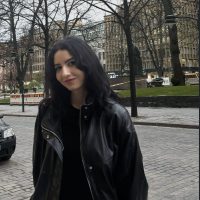
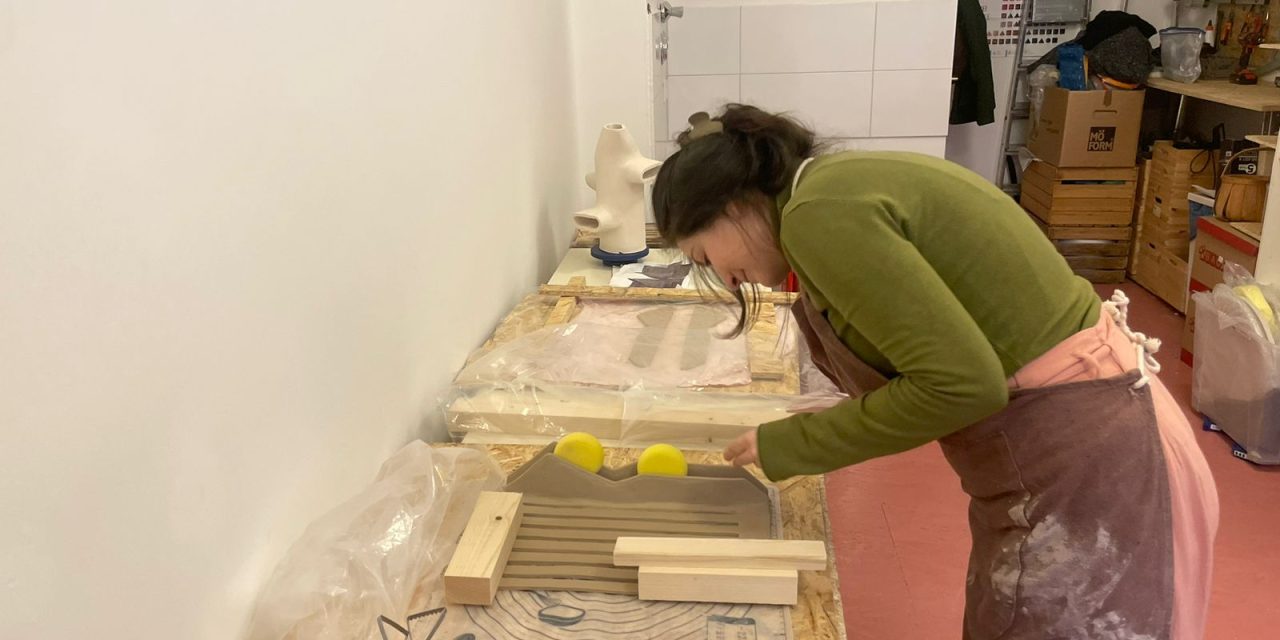
The story of Georgian artist Elisabed Zautashvili reflects this reality. She is a Berlin-based ceramic artist and architect. Her parents were painters, but she found her own path through architecture, product and interior design, and eventually ceramics. After moving to Berlin at the age of 27, she began her master’s studies in Germany. Eight years later, she has her own new studio where she creates different types of sculptures, including light sculptures and experimental artworks.
Elisabeth also works as an exhibition designer, and she describes her job as both “creative and technical.” She works four days a week, and every project is different and fascinating for her.
“I think the four-day work week is very important. I really love my job. It’s not like I work just to earn money… it’s not like that. I like not only the creative side of my job but also the technical side, because I studied architecture and I liked that as well. My job is largely creative, but I also do project management. I come up with ideas together with curators and museums, I communicate with architects, I review plans, and I work with graphic designers and media people.”
Elisabed draws inspiration from both architecture and nature.
[aesop_image img=”https://svjmedia.nl/internationaljournalism/wp-content/uploads/sites/378/2026/04/WhatsApp-Image-2026-04-24-at-14.46.11-1-1-scaled.jpeg” panorama=”off” credit=”Nina Getsadze” align=”center” lightbox=”on” captionsrc=”custom” caption=”Light Sculpture made by Elisabed Zautashvili” captionposition=”left” revealfx=”off” overlay_revealfx=”off”]
“Inspiration can be different. Often, architecture is my inspiration, late Soviet architecture, or it can be nature. I have a forest in front of my house, I go there often and I really love it… sometimes it can be both.”
She believes she was lucky to find her job, but also emphasizes that she actively searched for it.
“I got very lucky and I also searched a lot… After some time, you start having a dialogue with yourself, you have to convince yourself, no one else will help you except yourself.”
She is currently preparing for new exhibitions. In May, she will present a 12-part artwork made with different shades of green and light blue, created using various materials and firing techniques.
“It looks like you are looking from an airplane, like a landscape from above, with lakes and mountains.”
When she loses motivation, especially when her work is not selling, she uses her own methods to continue. First, she reminds herself that she is creating for herself. Second, she revisits her works to see what she has already achieved.
[aesop_image img=”https://svjmedia.nl/internationaljournalism/wp-content/uploads/sites/378/2026/04/WhatsApp-Image-2026-04-24-at-14.46.11-2.jpeg” panorama=”off” credit=”Nina Getsadze” align=”center” lightbox=”on” captionsrc=”custom” caption=”Elisabed Zautashvili’s artworks” captionposition=”left” revealfx=”off” overlay_revealfx=”off”]
“When I can’t sell anything, my motivation drops a lot at some point, and then I tell myself: you enjoy this, so just do it for yourself.”
“I read somewhere that you should take your work out and look at it again, and then you go back into the mood to continue.”
Elisabed’s experience shows how one artist has found a way to combine financial stability with creative work. Her story demonstrates that pursuing art does not always require choosing between passion and practicality.